
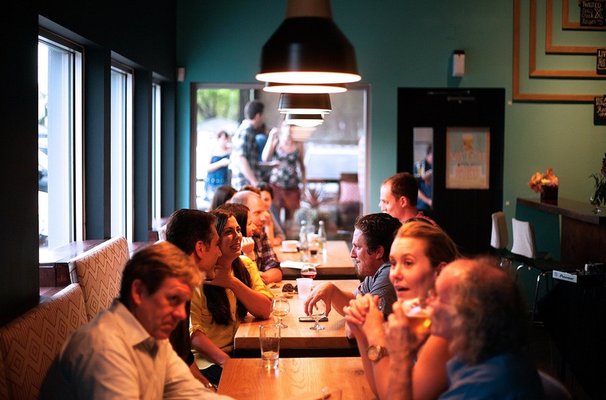
Dubai-based interior design firm, Roar, has released a White Paper, outlining how the coronavirus will change the way restaurants operate. Some changes may be short-term, but others look like they are here to stay.
A survey was conducted for the White Paper, in which 170 industrial professionals took part, revealing just 26% think a return to normal spacing will happen before the end of the year. Most participants (64%) expect that to happen in 2021, while a small majority of 5% say the restaurant trade will never return to normal.
“Safe spacing will be the most dramatic impact on restaurants – but according to our experts, one that is likely to be short-lived,” said Pallavi Dean, founder and creative director of Roar.
Restaurants in Dubai are looking to reopen, at 30% of their usual capacity, to ensure social distancing guidelines are followed. A contactless, or ‘contact-light’, dining experience is expected to be the new normal too, at least in the near future. Physical menus may become rare, along with the communal salt and pepper shakers and bottles of sauce. Contactless payments may become mandatory, especially for mid-market and above restaurants.
Guests can also expect to see more of the Japanese-style contactless restroom, in the fight against the spread of the virus. Sensor opening doors, along with taps and soap dispensers operated through sensors will lead to guests rarely touching surfaces in bathrooms again. The technology for this already exists, all that is now needed is a worldwide rollout.
Does the contactless dining experience spell the end of the buffet? 75% of survey participants agreed that the sharing concepts and buffets cannot survive in their present form. This could have a major impact on the hotel industry, with many hotels operating with buffets to cater to thousands. We may not see 1,000 room hotels in Dubai suddenly ripping apart their buffet areas, but there has been a shift in recent years towards a la carte dining and brunches, COVID-19 may just have accelerated the shift.




Trends in restaurant design had been leading us to a more contactless society, pre-COVID-19, and we will continue to see these trends develop. We are seeing an increase in automation, through robots and apps, for example in China many restaurants already rely on robots as part of their service. The demand for greater originality and escapism from design concepts will only continue to grow.
The White Paper also looks at one of the more profound effects COVID-19 has had on the general public, our psychology. Many of us are eager for shops, bars, and restaurants to reopen. Activities that allow us to socialize, with home isolation becoming more challenging. Others may feel more anxious and cautious than ever before, with a real feeling of uncertainty in almost everything we do. This could lead to a new standard of sanitation, along with open kitchens for transparency, making dining out again a comfortable experience.
These trends could shape the future of the hospitality industry. The difference between a short-term fix and a long term solution is the multi-million dollar problem.
To view the original White Paper, click here.


