
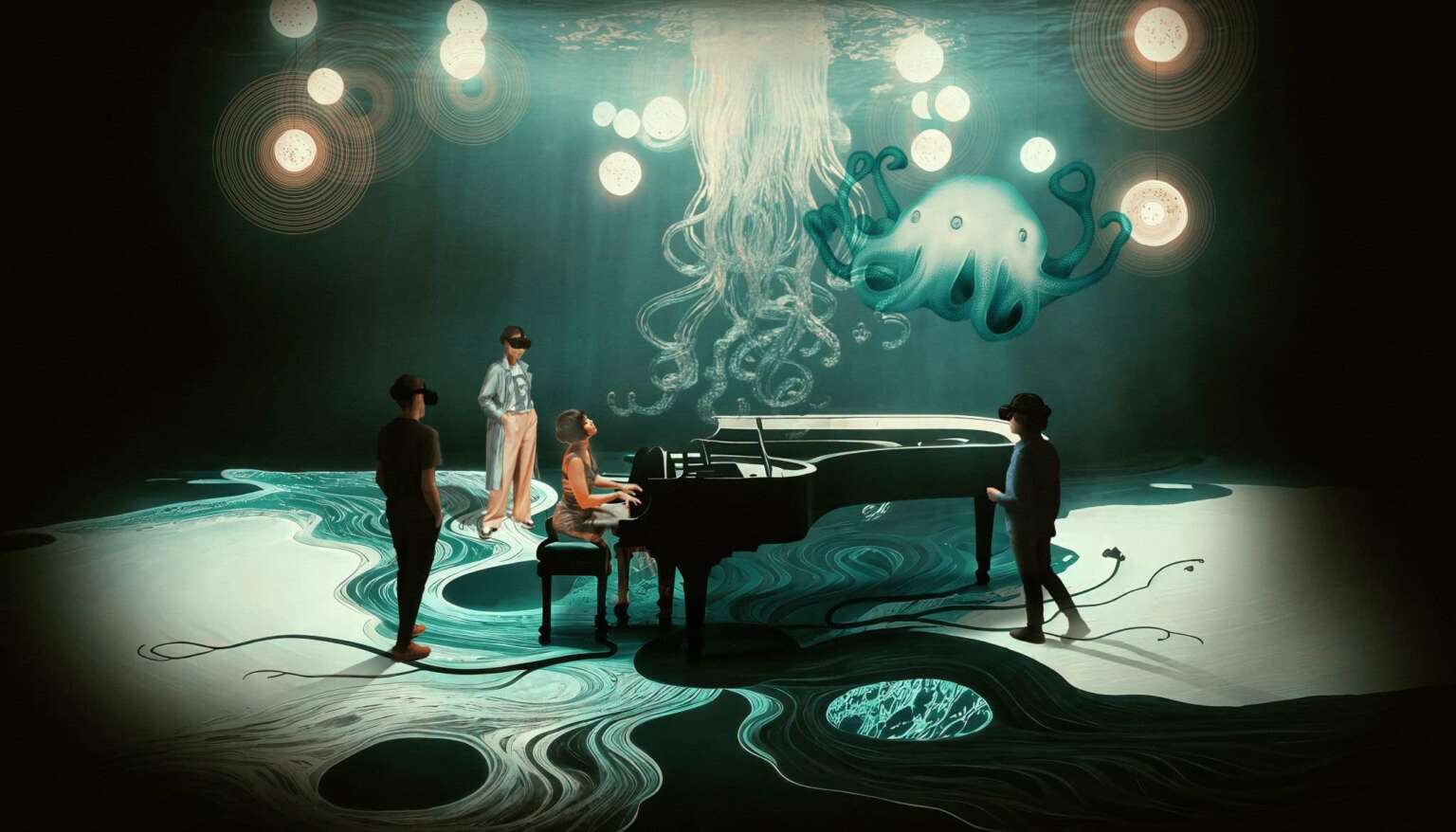
London’s Southbank Centre has launched Playing With Fire: An Immersive Odyssey with Yuja Wang, a mixed-reality exhibition that places classical performance inside a spatial digital environment.
Opened on 24 September 2026 and running until 3 January 2027, the experience has been written and directed by Pierre-Alain Giraud. It presents an avatar of pianist Yuja Wang within a virtual 3D environment, while the music is delivered through a real self-playing Steinway Spirio piano.
For cultural venues, concert halls and immersive experience producers, the project is significant because it extends the recital format beyond the fixed relationship between stage and seat. Instead of watching from an auditorium, visitors can move around the virtual performance and experience the pianist from perspectives that would not be possible in a conventional concert setting.
Technology Connects Physical Sound And Virtual Presence
The experience has been developed with VIVE Arts and Atlas V, using volumetric capture to record Wang’s performance and present it through VR headsets. Audiences encounter the pianist as a virtual figure, while the Steinway Spirio delivers the recorded performance through a physical instrument in the space.
This combination of real acoustic output and virtual visual presence creates a hybrid model for performance presentation. It avoids relying solely on headset audio by retaining the materiality and resonance of the piano, while using VR to expand the audience’s visual and spatial relationship with the performer.
For B2B stakeholders, the format raises important questions around the future of music programming, touring and venue activation. High-quality capture of elite performers can allow institutions to present new types of work without replicating a traditional live recital model. It also creates possibilities for extended runs, flexible capacity and repeatable installation formats.
Curated Repertoire Supports The Experience
Wang has selected works by Debussy, Ravel, Bach, Stravinsky and Prokofiev for the exhibition. The programme gives the project a broad musical framework, moving across different textures, periods and emotional registers.
The sound world is supported by live visual environments, including night skies, molten forms and waterscapes. Fragments of poetry by Paul Verlaine are also incorporated, adding a literary layer to the production.




For immersive designers, this multi-artform approach is central to the exhibition’s value. Music, poetry, spatial design and visual effects are not presented as separate additions, but as interdependent parts of the audience journey. The result is a production that uses technology to deepen interpretation rather than simply surround the listener with spectacle.
New Opportunities For Performing Arts Venues
The Southbank Centre project reflects a wider shift in how performing arts venues are exploring digital and immersive formats. Concert halls and arts centres are increasingly looking for ways to reach audiences beyond standard stage presentation, while still protecting artistic quality and credibility.
Playing With Fire demonstrates one possible route. It keeps the musician’s performance at the centre, but changes the audience’s mode of access. Visitors can experience proximity, movement and scale in ways that would be impractical or disruptive during a live recital.
This has potential relevance for venues seeking to activate foyers, galleries, studios or temporary exhibition spaces. It may also support education, audience development and cross-disciplinary programming, particularly when linked with curatorial interpretation and talks.
Relevance For The Visitor Experience Sector
For Experience UK’s audience, Playing With Fire is a useful case study in the convergence of classical music, immersive technology and cultural venue programming.
The project shows how established art forms can be reworked for new spatial formats without losing their artistic foundation. It also highlights the growing role of volumetric capture, VR, spatial sound and responsive visual environments in cultural production.
As visitor expectations continue to shift, institutions are exploring ways to make performance more intimate, flexible and accessible through technology. Southbank Centre’s Yuja Wang exhibition positions the recital as a living format, capable of moving between concert hall tradition and immersive installation design.


