
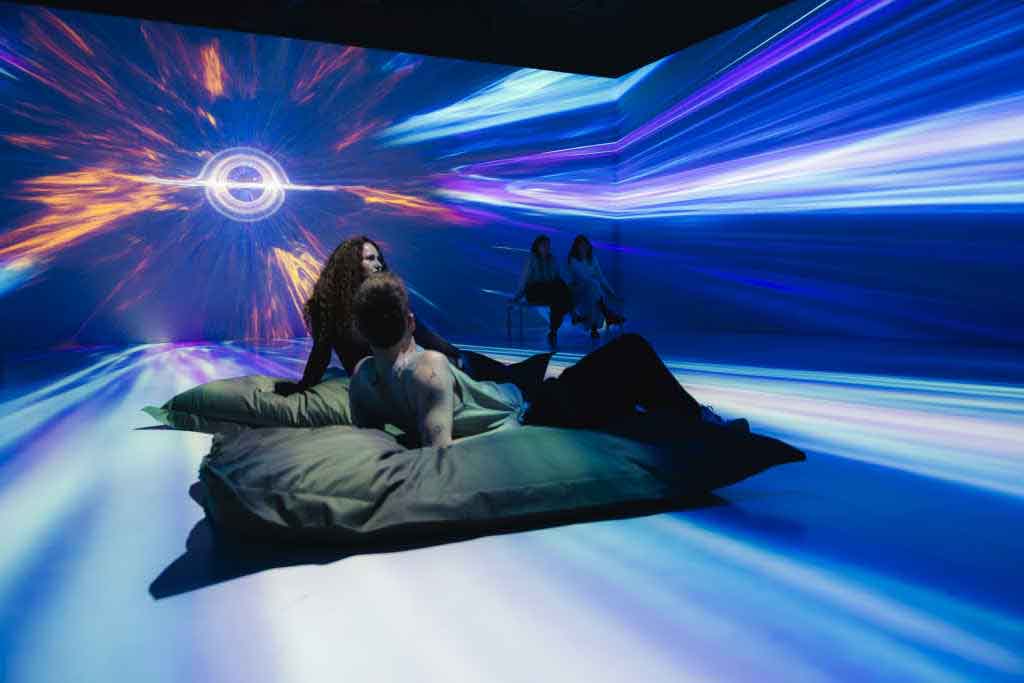
Signal Space in Prague has gained international recognition after Signal Space: Echoes of Tomorrow won the Arts & Experience category at the 2026 Inavation Awards. The achievement highlights a technically ambitious opening exhibition, but it also points to a wider story for the visitor experience sector: the creation of a permanent digital arts venue built for repeated change.
Opened to the public in September 2025, Signal Space occupies 2,500 sq m within Prague’s heritage-protected Old Town Market Hall. The approximately €2.4 million project was developed as a year-round platform for immersive art, AV-led events, education and temporary programming, rather than a single-exhibition installation.
Echoes of Tomorrow brought together digital artists and studios including Nohlab, Playmodes, Shohei Fujimoto, onformative, Zach Lieberman, Ondrej Zunka and Preciosa. The exhibition includes large-format projection, spatial audio, kinetic systems, lasers, interactive displays and an Infinity Room. For venue operators, designers and AV partners, however, the most significant aspect is the technical infrastructure supporting future programming.
Working Within A Protected Historic Site
The Old Town Market Hall, completed in 1896, presented demanding design and installation conditions. Its cast-iron, wood and glass structure is protected, while later additions, including a false ceiling from the 1980s, also had to be considered. The project team was required to work with tight limits on physical intervention, with changes needing to remain reversible.
AV Media joined the scheme in December 2024 to support AV and technology design, installation and maintenance. The team had to respond to site conditions as rooms were opened up, with the main Immersive Space presenting one of the clearest examples of adaptation.
The 300 sq m room uses 19 Panasonic 4K laser projectors to create a 22.7K wraparound projection environment across walls and floor. The system combines 14 PT-REQ12 and five PT-REQ15 projectors, driven by four Virtuality.one PixelBox media-server nodes running AV Stumpfl Pixera. Hardware synchronisation keeps multi-projector output aligned.
The hall’s original sloping floor, designed for market washdown, created a major projection-mapping challenge. With a 25cm fall across the space, the team had to adjust the projection system so visitors would not notice the uneven surface.
Technical Infrastructure Built For Change
Across Signal Space, projection is the dominant visual medium. The venue operates 38 projectors, with additional reserve equipment. Panasonic models are used across different rooms, including PT-RQ7 units in the Cinema Studio and PT-MZ882, PT-VMZ6ST and PT-MZ11KL projectors elsewhere.




Eight Virtuality.one PixelBox media servers provide the core playback infrastructure. Pixera supports the main Immersive Space, while Resolume is used for smaller blended projections. QLab manages audio cues, elements of lighting control and ambient audio, while Unity and TouchDesigner support interactive exhibits.
Universe Control sits above these systems as the venue’s management platform. It schedules start-up and shutdown, reports device status and allows new scenes or equipment to be added without specialist programming. This is vital for a venue where artists, room uses and event formats may change regularly.
The network infrastructure is physically separated into dedicated planes for Pixera and video, primary and secondary Dante audio, and control. This structure gives the venue stability while allowing artists and technical teams to work with different tools.
Audio is delivered through JBL, Bose, LEA, BSS and Dante-based systems, with Sennheiser wireless microphones available for events. Lighting includes more than 500 Halla luminaires with DALI control, supported by Spectoda technology for responsive artistic lighting.
Operational Lessons For Experience-Led Projects
Signal Space also shows the operational demands of permanent immersive venues. Mechanical works, lasers, projectors and interactive systems require daily technical oversight, spare parts and remote monitoring. The venue uses UPS protection, Panasonic monitoring and device reporting through Universe Control, while staff also inspect spaces directly throughout the day.
The project’s long-term value lies in its readiness for new content. Some spaces, such as the calibrated 19-projector room, are relatively fixed. Others are prepared for revised cabling, sockets, rigging and control logic.
For attraction operators, cultural venues and AV suppliers, Signal Space offers a useful case study in designing immersive infrastructure around future programming, not just opening-day impact.


