
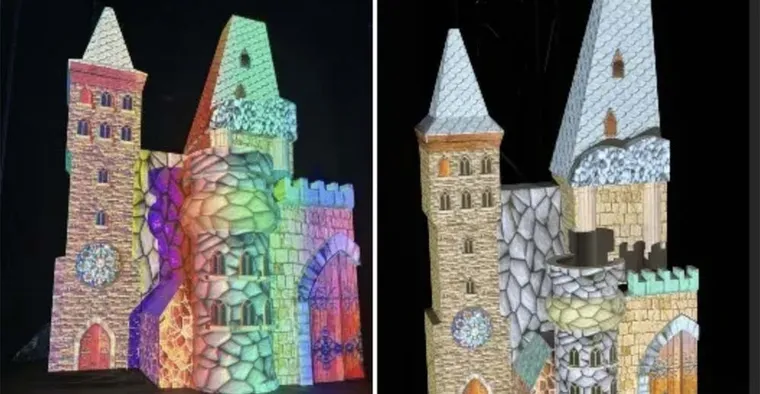
InfoComm 2026 will see Scalable Display Technologies present a large-scale 3D projection mapping demonstration, using a custom-made Mount Rushmore installation to show the capabilities of its Atlas automatic calibration platform.
The demonstration has been developed to mark America’s 250th anniversary and will take place during InfoComm 2026 at the Las Vegas Convention Center from 17 to 19 June.
For AV integrators, attraction designers and themed environment specialists, the showcase will provide a practical example of how automatic calibration can support complex multi-projector installations on unusual surfaces.
Automatic Calibration For Complex Surfaces
Atlas has been designed to manage image alignment across environments and 3D objects, colour matching, edge blending and geometric correction.
During the show, Scalable will be re-running the calibration process after deliberately disrupting the projector alignment. This will demonstrate how Atlas can, with limited manual input, restore a continuous projected image.
Traditional projection mapping often requires detailed manual setup, particularly when working across sculptural forms, architectural facades or themed scenic elements. Atlas uses camera-based calibration to calculate projector positions in 3D space, then creates the required warping for each projector based on those positions.
For operators, this has clear implications for installation time, repeatability and maintenance. In live venues, museums, visitor attractions and immersive rooms, projector drift or environmental changes can create operational issues. Automated recalibration can help reduce downtime and support more consistent visual performance.
Extending Beyond Simulation Markets
Scalable Display Technologies has an established background in simulation and training environments, where projection systems often operate on defined screen geometries.


Atlas marks a broader move into applications where surfaces are less predictable. This includes sculptures, branded installations, public art, heritage interpretation, architectural projection and attraction environments.
The Mount Rushmore installation has been selected to highlight this wider application. Its recognisable 3D form gives Scalable a clear way to demonstrate the platform’s ability to handle depth, contours and uneven geometry.
For experience designers, this development is relevant because projection mapping is now used across a wide range of cultural and commercial settings. As projects become more ambitious, software that can reduce manual alignment work may support both creative flexibility and operational reliability.
Value For Attractions And Immersive Venues
Projection mapping remains an important tool for visitor experience projects, particularly where physical sets, scenic structures or historic buildings need to carry changing content.
Scalable’s demonstration points to a future where complex mapped environments can be easier to commission and maintain. This could be valuable for permanent attractions, touring exhibitions, museums, corporate experiences and live event spaces.
For integrators, the ability to recalibrate quickly may also support projects with tight installation windows or frequent content changes. For venue operators, it may reduce the reliance on specialist technicians for routine alignment work.
The InfoComm showcase will position Atlas as a tool for teams working beyond flat screens and standard display surfaces. By applying automatic calibration to a 3D Mount Rushmore model, Scalable aims to show how projection mapping workflows can become faster, more flexible and better suited to the needs of modern immersive environments.


