
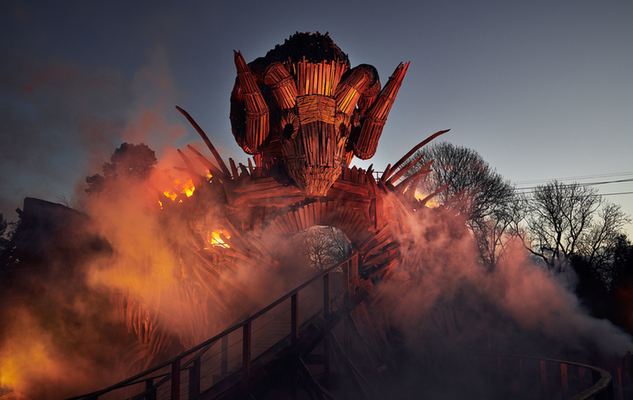
Methods of immersing guests into storylines and narratives have become a staple of the attractions and visitor experience industries. Even rollercoasters, which have traditionally just focused on the end thrill are now being driven by story, as guests move through queuing areas that are alive with immersive content.
Wicker Man, the latest coaster to open at Alton Towers Resort, UK, is a great example of this, as the multisensory experience puts guests at the heart of the terrifying story before they board the park’s first wooden coaster.
From the moment guests enter the queue line, surround audio and immersive media feature throughout and into the preshow, station loading zone, enclosed sections, exit and within the Wicker Man structure.
Taking this a step further, experiences can be personalised to establish an emotional connection with each guest. This helps create memories that they will talk about and share for years to come. It also leads to content rich social media shares, making the marketing message travel further.
“We use real-time media to put guests in control of their journey, unlocking multivariant and personalised narrative experiences depending on the decisions they make or paths they choose to take,” explains Peter Cliff, creative director of experience design company Holovis.
“This enhances the engagement as people share with their friends what they have discovered, whether in an entertainment or educational environment, allowing guests to work together to unlock more of an adventure’s secrets.
“This can also continue away from the physical location, with games or challenges that guests can complete at home to continue their journey. Then when they return to the original location the experience will have changed to reflect their progress. This is a great way of encouraging repeat footfall.”
The idea of extending and enhancing the guest experience can also have a functional as well as entertaining purpose, as it is a great way of turning the queue line, a traditionally passive and sometimes frustrating experience into an active part of the attraction.
One challenge is how to achieve elements of personalisation during what are supposed to be shared group experiences when spending a day at a theme park with friends.
Peter Cliff Creative Director Holovis



“On the one hand, solutions like Virtual Reality haven’t been widely adopted because they detract from the shared group experience by locking people away in headsets, so they can no longer engage with their friends,” explains Cliff. “On the other hand, they are a really easy way of giving guests a personalised experience because the content can be exclusively seen and controlled by them.
“Our goal is to combine the two, facilitating personal experiences but in a shared space, so guests can share their discoveries with their friends to further enhance the experience for everyone.
“In the case of a museum for example, the decisions made by each guest can unlock a new piece of information, tailored to their interests. They can then share this discovery with their friends and see what different information they have unlocked to bring the space and artefacts to life in more dynamic ways.”
An alternative key and emerging technology that has enabled this higher degree of individual engagement is Augmented Reality.
This was the backbone of the Holovis Extended Experience platform, which first launched in 2016 to present The Battle For Cedar Point at Cedar Point theme park in Ohio, US. Guests download the app onto their smartphones and once in the park it gamifies and transforms traditionally passive experiences into game areas, immersing people into the previously undiscovered and interactive story of the rollercoasters of Cedar Point.
“We’ve evolved this so that guests no longer need to use a phone, or any other handheld device or prop,” continues Cliff. “We now use invisible tracking and recognition technologies that facilitate the experience, making it feel like true magic to the guest. This includes CAD tracking, machine learning, facial recognition, AI, WIFI triangulation and geofencing.
“We believe that the future lies in the personalised experiences that people are having not just being limited to something that reveals itself to them, but that has a real-world impact in conjunction with what other guests are doing.
“Projection mapped shows for example often follow a set media path, facilitated by the same technology sequences that happen every evening. We want to be able to alter that show in real-time based on the physical, intellectual and emotional responses of the audience. This is achieved through our data generation methods which can identify audience moods, or by using sensory technologies such as noise and gesture responses that can change the path of the story.”
To find out more about Holovis and their range of services, please visit their members page.


