
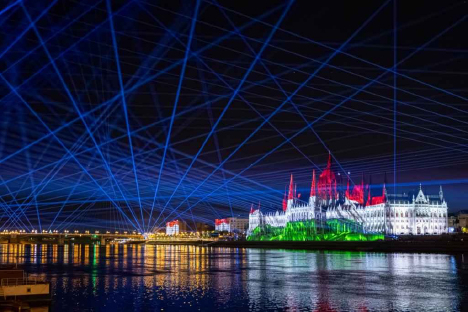
Panasonic Projector & Display technology played a central role in Hungary’s St Stephen’s Day celebrations, supporting a major projection mapping programme across some of Budapest’s most recognisable civic landmarks.
The annual event, held on 20 August, commemorates King Stephen I and the foundation of the Hungarian state. In Budapest, the celebrations are among the country’s most prominent public events, with activity traditionally focused around the Hungarian Parliament Building and the River Danube.
For this year’s production, 67 Panasonic PT-RQ45K and 16 PT-RQ35K laser projectors were used to deliver large-format projections across both sides of the Hungarian Parliament Building, the Széchenyi Chain Bridge and buildings along the Pest side of the Danube. According to the project team, the installation marks the largest global deployment of Panasonic PT-RQ45K projectors to date.
For suppliers and operators working in live events, public art, cultural programming and city-scale AV, the project demonstrates the growing ambition behind civic celebrations. Major national events are increasingly using projection, lighting, lasers, drones, music and fireworks as part of integrated public productions designed for large urban audiences.
AV Systems Across A Historic Urban Setting
The main show was staged along the River Danube, using the area between Margaret Bridge and the Chain Bridge as a broad visual canvas. The production combined architectural projection mapping with multiple show technologies to present content linked to Hungary’s history and national identity.
After the main event, projections on the Parliament Building and Chain Bridge continued into the night. This extended the value of the installation beyond the central show moment and gave the production a wider public programming role across central Budapest.
From a technical perspective, mapping onto historic architecture at this scale requires close coordination across content design, projector placement, calibration, weather planning, sightlines, power distribution and crowd management. The Parliament Building and Chain Bridge are both highly visible assets with complex surfaces, meaning content has to be planned around architectural form as well as audience viewing positions.
The use of high-brightness laser projection is particularly relevant for public events of this kind. City-scale mapping demands sufficient output, image stability and reliability across long throws and challenging exterior conditions. For AV teams, equipment choice can have a direct effect on image quality, operational efficiency and the ability to deliver large visual sequences with consistency.


Specialist Collaboration Behind Delivery
The overall event was delivered by Centrum Production, with Dániel Besnyo serving as director and overall project lead. Gergo Geltz led the light art content, while Mátyás Kálmán acted as artistic director.
The production reflects how major outdoor events now depend on collaboration across creative direction, technical design, content production, projection engineering and municipal coordination. Projection mapping at this level is not only a visual layer. It becomes part of the civic event infrastructure, shaping how audiences experience national celebrations in public space.
For experience design companies, the Budapest project offers a clear example of how historic city settings can be activated through temporary media architecture. The approach allows organisers to present large-scale storytelling without permanent intervention in heritage sites, which is especially important for protected or symbolically significant buildings.
Implications For Public Event Producers
Panasonic’s role in the St Stephen’s Day production points to continued demand for robust projection systems in large public events. As cities compete to create memorable cultural calendars, projection mapping offers a flexible format for national days, festivals, anniversaries and tourism campaigns.
For the wider visitor experience supply chain, the project highlights opportunities across AV rental, content design, technical production, show control, public realm planning and live event operations.
Budapest’s use of projection across Parliament, Chain Bridge and the Danube frontage shows how city-scale productions can connect heritage, technology and public gathering in a single event format, while giving landmark architecture a powerful role in contemporary civic storytelling.


