
National Geographic has opened the Museum of Exploration in Washington DC, following a multi-year redevelopment of the National Geographic Society’s long-standing headquarters.
The new museum covers over 100,000 square feet of public space and represents a major expansion of the organisation’s previous museum offer. For the visitor experience sector, the project is notable for the way it connects archive material, photography, field research, media production, live programming and technology-led interpretation within one destination.
Rather than presenting a static retrospective, the museum has been designed around the wider process of exploration. Its galleries show how National Geographic stories are researched, documented, edited and shared, while also bringing current scientific and environmental work into public-facing spaces.
Emily Dunham, Chief Campus and Experiences Officer for the National Geographic Society, has positioned the museum as a shift from distance-based storytelling to direct participation. The aim is to let audiences engage with explorers, fieldwork and research through exhibitions, events and hands-on media.
Archives, Photography And Field Research
Photography remains central to the offer. The permanent gallery, In Focus: Photographs Of National Geographic, draws on over a century of image-making. Within it, the Spotlight Gallery will change roughly twice a year. Its opening display, Red, White, & Blue: Photographs Of The United States, brings together work linked through the colours of the American flag and is scheduled to run until January 2027.
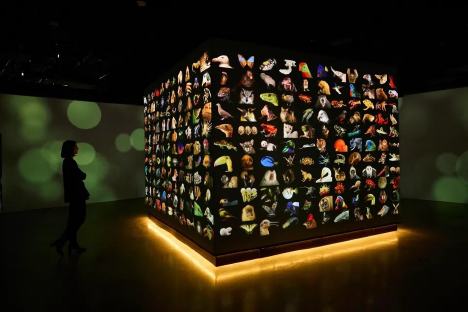
The main Exhibition Gallery will change each year. It opens with Photo Ark: Animals Of Earth, based on Joel Sartore’s long-running project to document species living in zoos, aquariums, sanctuaries and rehabilitation centres. The exhibition uses large-scale projections and sensor-based installations to present animal portraits alongside conservation themes.
Another significant area is The Archives, which gives access to field notes, maps, film reels and expedition materials. These objects support a deeper understanding of the work behind National Geographic’s published stories. For museum designers and curators, the space offers a useful model for making editorial and research processes visible to the public.


Visitors can also explore how a magazine story develops from field assignment to final layout. Other installations focus on cartography, filmmaking and archive selection, including digital tables with hundreds of photographs, audio clips, film extracts and collection items.
Technology In Service Of Storytelling
The museum uses technology across several major experiences, but the focus remains on interpretation. A 270-degree theatre uses mapping, geographic data and visual layers to explain how researchers study scale, time, patterns and place. One programme takes audiences into Australia’s Great Victoria Desert, using interactive content to examine ecology, plants and wildlife.
Outdoor areas extend the museum’s offer beyond the galleries. Daytime augmented reality features place animals within the courtyard, supported by ecosystem-inspired installations. At night, the space hosts Wonders Of Our World: Ocean, a 17-minute experience developed with Montreal-based multimedia studio Moment Factory. Screens, lighting, spatial sound, smart glass and responsive floor projection create an ocean-focused environment with a strong public programming role.
Accessibility has also been built into the scheme, with English and Spanish signage, Braille wayfinding, captioning, visual descriptions, American Sign Language and tactile photography elements.
A Changing Museum Model
For B2B audiences, the Museum of Exploration shows how cultural institutions can use rotating exhibitions and live events to support repeat visitation. Annual main exhibitions, twice-yearly photography displays and ongoing explorer-led programming create a content model that can refresh the offer without rebuilding the entire museum.
The project also reflects wider demand for cultural venues that combine archive access, digital media, education, live discussion and sensory design. For experience designers, museum planners and technology partners, National Geographic’s new museum provides a valuable example of how a media organisation can convert its research legacy into a contemporary visitor destination.


