
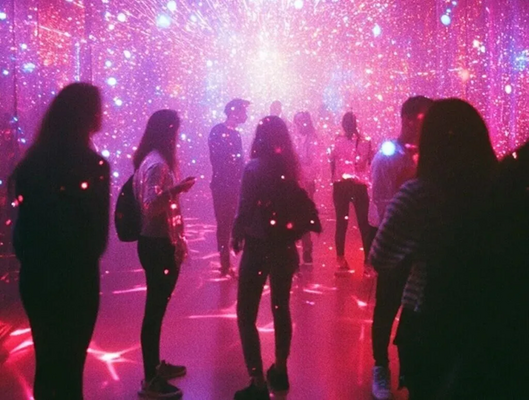
Merlin Entertainments has announced the launch of two new immersive attractions in the US, reinforcing its strategic move into experience-driven, mood-responsive environments. Developed in collaboration with Fever, the experiences will open in September at high-footfall retail destinations: Woodfield Mall in the Chicago area and the Mall of America in Minneapolis.
Wondra, opening 5 September, invites guests into a nature-themed interactive space inspired by human connection to the natural world. Meanwhile, Super Neon, debuting on 12 September, delivers a light-focused environment designed to elevate mood and engage the senses through immersive storytelling and sensory design.
Both projects were conceived by Merlin’s internal creative division, Merlin Magic Making, and executed within an accelerated development timeline, highlighting Merlin’s adaptability in responding to cultural trends and market demands.
Adaptive Design to Match Visitor Trends
Wondra and Super Neon’s concepts are rooted in consumer preferences for tactile, photogenic, and emotionally engaging experiences. In the 11,500-square-foot Wondra, visitors move through surreal environments such as interactive meadows, dynamic sky scenes and oversized flora, designed to provoke curiosity and reflection on the natural world.
At Super Neon, spread across 11,700 square feet, the focus shifts to immersive lighting. Scenes include a neon-lit storm complete with hanging underwater umbrellas, alongside a digitally animated forest with reactive lighting elements. The installation aligns with a growing demand for experiences that combine visual impact with mood-lifting design.
By integrating immersive storytelling, interactivity and sensory layering, these attractions demonstrate Merlin’s capacity to diversify beyond traditional formats and embrace location-based entertainment as a platform for innovation.
Collaboration with Fever Highlights Platform-Led Rollout Strategy
The partnership with Fever, a global platform for event discovery and ticketing, represents a shift in how attractions are marketed and distributed. Fever’s platform-centric model enables Merlin to reach digitally active audiences, particularly in urban areas, while streamlining visitor booking pathways and data collection.



This collaboration also allows Merlin to pilot experiential concepts more rapidly. By combining Merlin’s in-house creative expertise with Fever’s agile distribution network, both Wondra and Super Neon have been developed and delivered within a one-year cycle, a notable departure from the longer lead times typical of fixed-location attractions.
The model presents a blueprint for accelerated development without sacrificing quality or thematic depth for experience designers, operators, and content producers.
Positioning Within the Evolving Immersive Experience Sector
These new additions reflect a broader trend toward thematically rich, lower-footprint experiences capable of being deployed within commercial real estate settings. Unlike full-scale theme parks, Wondra and Super Neon are designed for flexible integration into shopping centres and high-traffic mixed-use environments, opening new avenues for location-based entertainment operators.
The modular nature of these installations also suggests scalability, with potential for seasonal updates, regional rollouts or brand partnerships. For real estate developers, retail property managers, and entertainment investors, Merlin’s move provides insight into how immersive content can revitalise underutilised space and drive consistent footfall.
By pairing strong creative IP development with responsive operating models, Merlin and Fever are positioning themselves at the forefront of experiential entertainment. The launch of Wondra and Super Neon signals the company’s intent to remain competitive and relevant in a market increasingly defined by sensory immersion, shareability and emotional resonance.


