
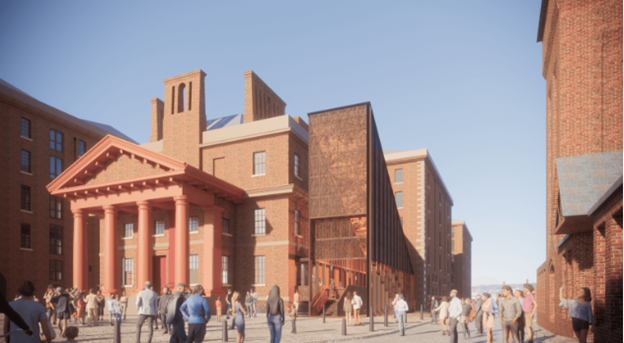
Liverpool’s historical waterfront is poised for a transformative renewal as Feilden Clegg Bradley Studios (FCBStudios) unveils its design for the ambitious renovation of the International Slavery Museum and Maritime Museum. Part of the sweeping Waterfront Transformation Project, this $74 million endeavour will revitalize Liverpool’s Mann Island, with these museums at the heart of the regeneration.
Last January marked a pivotal shift in the project’s direction when National Museums Liverpool appointed FCBStudios, replacing Adjaye Associates. This change came with a fresh infusion of academic prowess from University of Liverpool professors and a PhD candidate, promising a reinvigorated approach to the museums’ narratives.
The renderings from FCBStudios reveal a thoughtful architectural design with a pitched roof and perforated screens – a mix of functionality and aesthetics, leading visitors to the museum via an ADA-compliant ramp. Inside, the exhibition journey designed by Ralph Appelbaum Associates awaits, promising to encapsulate and convey powerful narratives through interactive and immersive displays.
The International Slavery Museum, a trailblazer since 2007 as the world’s only national museum dedicated to the transatlantic slave trade and modern slavery, will expand beyond its current third-floor space. A new extension adjacent to the Dr Martin Luther King Jr. Building will feature coral-coloured columns, offering a dignified main entrance that both respects and revitalizes the institution’s presence along the historic waterfront.
The new spaces aim to deepen the exploration of the transatlantic slave trade’s legacies. The integration of the museum with its surroundings is meticulous – the triangular volume of the new structure is designed to blend subtly with the masonry buildings and cobblestone paths that lace the Royal Albert Dock.




The Maritime Museum is set to receive a significant face-lift as well. The Hartley Pavilion will undergo improvements to facilitate visitor circulation, alongside the addition of a new shop, cafe, and spaces for events and exhibitions. A darker-toned glazed passageway will add a layer of historic aesthetic to the modern structure, bridging it with the Dr. Martin Luther King Jr. Building.
Visitors will also be greeted by a redesigned entrance for the Maritime Museum, featuring updated signage and a ramp and stair system doubling as impromptu seating, promoting both accessibility and spontaneous social encounters. A glass volume with wooden fins will artfully extend from the existing brick façade, creating a harmonious transition space that nods to both the museum’s maritime focus and its physical context.
Financed by a combined $24 million from the National Lottery Heritage Fund and the government’s Department for Levelling Up, Housing, and Communities, this project is a testament to the value placed on cultural storytelling and architectural heritage.
Scheduled to close in spring 2025 for renovation and slated for a grand reopening in 2028, these two museums are embarking on a journey of renewal that mirrors the city’s own path of reflection and progression. As Michelle Charters, head of the International Slavery Museum, asserts, these proposals represent a significant new chapter not just for the museum but for Liverpool itself, confronting its historical role in the transatlantic slave trade.


