
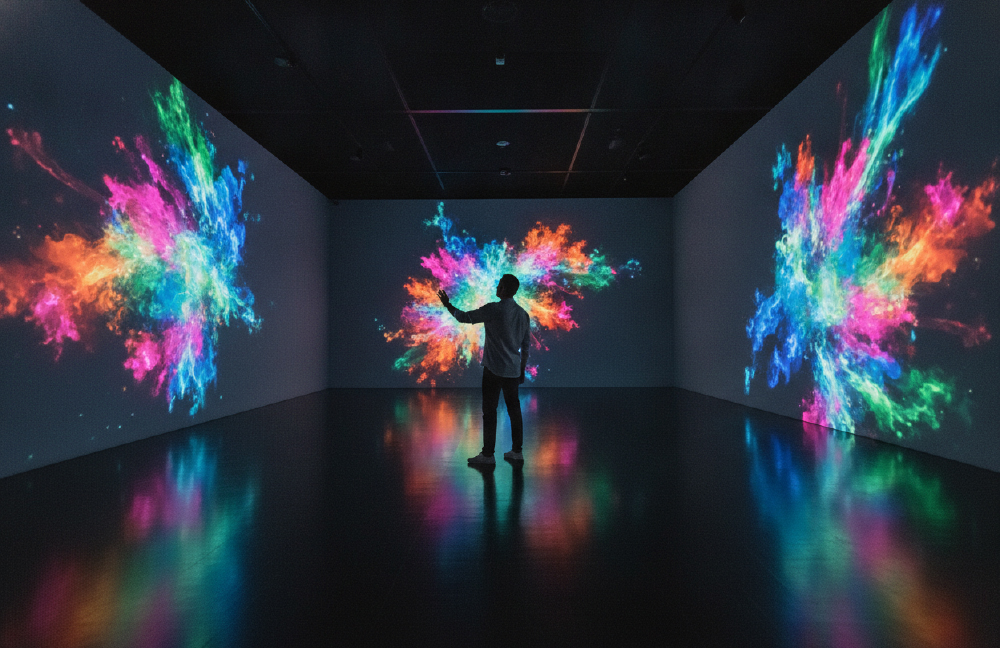
Immersive Arts has secured £8.5 million in second-phase grant funding to extend its UK-wide programme supporting artists and creative teams working with immersive technology.
The new funding will allow the programme to continue through to 2030, building on an initial £6 million investment launched in 2024. The second phase is backed by five public funders, led by the Arts and Humanities Research Council, alongside Arts Council England, Arts Council of Wales, Creative Scotland and the Arts Council of Northern Ireland.
For the visitor experience, cultural and creative technology sectors, the funding signals continued public-sector confidence in immersive media as a driver of artistic development, audience engagement and creative economy growth. It also positions artists and creative practitioners as central to the development of new technology-led experiences, rather than placing the focus solely on platforms or hardware providers.
Direct Support For Artists And Creative Teams
More than £4.7 million of the new funding will go directly to artists through grants, training and professional development. The programme will also introduce additional support for practitioners ready to commercialise their work, including business guidance and connections to funders and investors.
This is particularly relevant for creatives working across projection, extended reality, spatial audio, interactive storytelling, installation art and digitally supported performance. Many of these practices sit between cultural production, R&D and commercial experience design, making access to both artistic and business support essential.
The first phase of Immersive Arts has already awarded more than £3.24 million to 225 creative teams and reached over 2,300 artists across the UK. All five original funders and 10 founding consortium partners are continuing, giving the programme a stable national structure for its next stage.
The funding announcement was made by Professor Verity McIntosh of the University of the West of England Bristol at The Big Thing, the programme’s annual gathering in Llandudno, Wales.



Building Skills For A Developing Market
The next phase of Immersive Arts comes at a time when venues, festivals, museums, galleries and commercial attractions are increasingly seeking artists who can work with interactive and immersive formats. Demand is rising for creative teams able to combine strong ideas with technical delivery, accessibility, audience insight and operational awareness.
By funding training and professional development, the programme can help strengthen the talent pipeline for organisations commissioning immersive work. This has clear relevance for Experience UK’s audience, including attraction designers, cultural venues, live event producers and technology suppliers seeking creative collaborators.
The addition of commercialisation support is also significant. Immersive projects often begin as research or experimental artworks, but many have potential to scale into touring installations, venue-based experiences, licensing models or partnerships with cultural institutions and brands. Helping artists prepare for funder and investor conversations could improve the route from prototype to market-ready production.
A National Signal For Creative Technology
Programme leaders have highlighted the breadth of disciplines, backgrounds and lived experiences represented among applicants to date. Watershed’s Ruth McCullough, executive producer of Immersive Arts, has also indicated that the new funding will allow the programme to support both established practitioners and newcomers.
For the wider sector, the £8.5 million award is an important signal. It shows that UK public funders view immersive technology as a meaningful part of cultural and economic development, not simply a short-term trend.
As the programme moves towards 2030, its impact will likely be measured not only in grants awarded, but in the strength of the creative pipeline it supports. For venues and experience developers, Immersive Arts could become an important source of new ideas, skilled practitioners and commercially viable immersive work rooted in artistic practice.


