
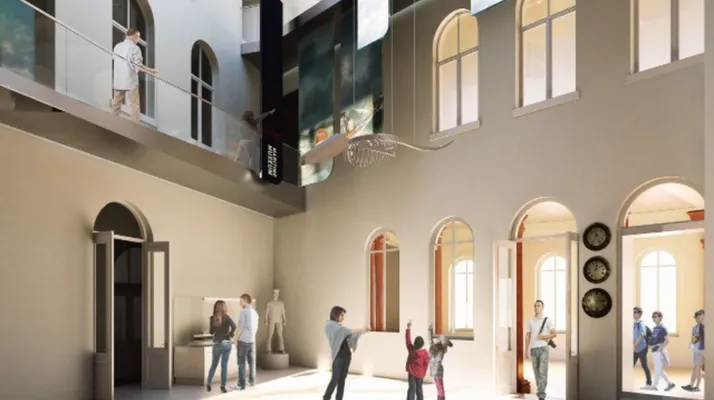
Hull Maritime Museum will reopen on Saturday 8 August following a six-year closure and a £20.4m restoration and redevelopment programme. The reopening marks a significant step in Hull’s long-term cultural regeneration strategy and strengthens the city’s position as a heritage destination with maritime history at its core.
The project has been funded through a combination of public, charitable and private support. £0.9m has been secured through private donations, £7.7m through the National Lottery Heritage Fund, and Hull City Council has contributed a further £11.8m. This funding mix reflects the local and national importance of the museum’s collection, building and interpretation programme.
Located in Queen Victoria Square, the museum occupies the former Town Dock Offices, a Grade II* listed building that opened in 1871. The site has a direct connection to Hull’s maritime past, with ships once passing close to the building. The museum itself was founded in 1912 as the Museum of Fisheries and Shipping before moving to the Dock Offices in 1975.
Expanded Galleries And Collection Access
The renewed museum will offer twice the previous public space and display 50% more objects from its collection. Around 1,300 items will be accessible across galleries and open storage areas, with many being shown publicly for the first time.
The collection is among the UK’s most significant maritime holdings. It reflects Hull’s 800-year relationship with the sea, covering trade, migration, fishing, exploration and whaling. For museum operators, curators and interpretation teams, the project provides a useful example of how a historic collection can be re-presented through modern gallery planning while retaining academic and civic value.
New permanent galleries will use refreshed displays, accessible interpretation and multisensory storytelling to communicate Hull’s maritime role across Britain and beyond. The approach is designed to connect historic material with broader themes including port economies, working lives, cultural exchange and the continuing role of Hull and the Humber as the UK’s busiest port complex.
Building Conservation And Visitor Infrastructure
The redevelopment has involved careful restoration of the former Dock Offices, combining heritage architecture with contemporary museum requirements. The scheme has been designed by Purcell, with restoration work carried out by Simpson of York.


For the cultural attractions sector, the project highlights the operational challenge of adapting listed buildings for current museum use. The renewed site brings together conservation, environmental control, public access, interpretation and long-term collection care within one civic heritage asset.
A new community exhibition space will allow the museum to present maritime stories from local and specialist organisations through objects, images and filmed material. Designed to national museum standards, the gallery will also allow the museum to host major loans and touring exhibitions, broadening its future programming capacity.
This element gives the museum stronger flexibility as both a local heritage platform and a venue able to participate in national exhibition networks. It also creates further scope for partnerships with maritime, social history, education and cultural organisations.
Heritage-Led Regeneration And Regional Value
Hull City Council has positioned the reopening as a major moment for the city’s cultural offer, with the restored museum intended to support local pride, visitor economy growth and wider engagement with Hull’s heritage assets.
The National Lottery Heritage Fund has also linked the project to the wider Hull Maritime programme, which is designed to connect communities and visitors with the city’s maritime identity. For destination managers and cultural planners, the reopening shows how museum investment can support place-based renewal when linked to public realm, heritage storytelling and civic identity.
The renewed Hull Maritime Museum is expected to become a key anchor within the city’s cultural infrastructure. Its reopening brings back a nationally important collection, restores a major historic building and creates a stronger platform for exhibitions, education and sector collaboration.


