
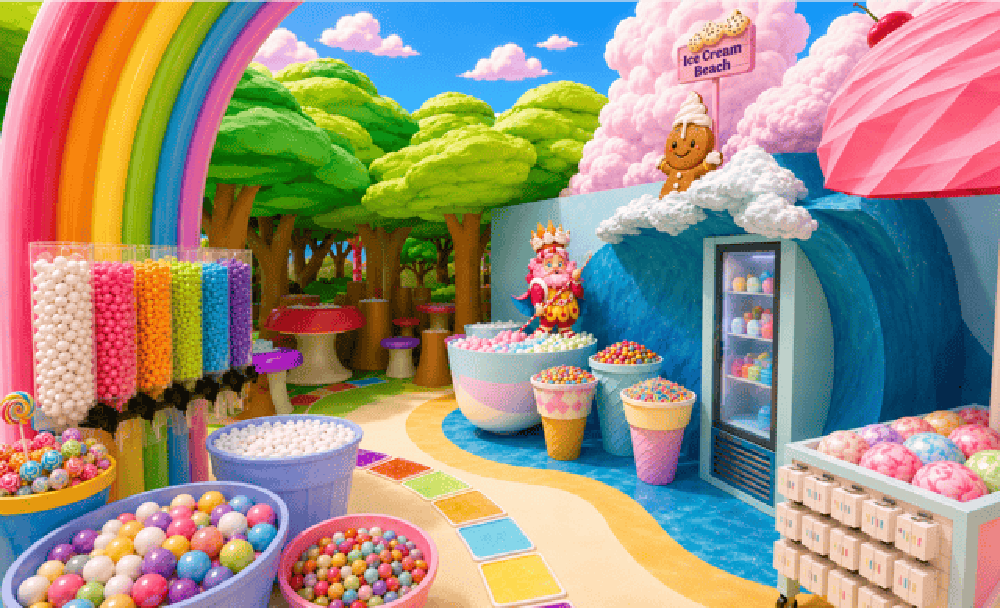
Event Network is preparing to open Candy Land NYC, an immersive retail destination in Midtown Manhattan developed under licence from Hasbro. The project adapts Candy Land, the children’s board game introduced in 1949, into a physical environment where themed installations and merchandise are organised around the game’s familiar route.
Presented as the first Candy Land store in the United States, the concept combines branded entertainment with a retail operation. Its design positions shopping within a sequence of themed settings rather than treating the store as a conventional collection of product displays.
Board Game Structure Shapes the Store Layout
The visitor route follows the logic of the original board game, with customers taking the role of players as they progress between distinct themed areas. Stops include Candied Apple Orchard and Lollipop Forest, each providing a recognisable setting within the wider Candy Land identity.
The route concludes at Candy Castle, a large-scale environment featuring graham cracker-inspired surfaces, ice cream-shaped turrets and oversized lollipops. The castle also houses the checkout, linking the final themed scene to the transaction process.
For designers of retail attractions, this arrangement illustrates how an existing intellectual property can inform circulation, spatial sequencing and commercial placement. The board game supplies a clear narrative structure, while the succession of themed locations creates opportunities for product discovery at different points in the store.
Merchandise and Confectionery Integrated Throughout
Candy Land NYC will sell confectionery alongside game-related toys, collectables, souvenirs, apparel and other licensed merchandise. Nostalgic sweets and beverages will form part of the assortment, extending the concept beyond a single product category.
Rather than concentrating sales activity in a shop at the end of an attraction, the format incorporates retail throughout the experience. That approach places merchandising decisions alongside scenic design, allowing individual product groups to sit within the visual identity of each themed zone.




The model may be relevant to operators considering how to combine dwell time, branded environments and purchasing opportunities. Its commercial performance will depend on factors not yet disclosed, including visitor throughput, average transaction values, operating costs and the balance between experiential space and selling area.
Event Network and Hasbro Develop Licensed Concept
The project has been developed by Event Network, a North American experiential retail specialist serving cultural attractions and destination venues, under licence from Hasbro. The partnership draws on a long-established family entertainment property with visual elements that can be translated into physical environments.
Event Network chief executive Larry Gilbert has positioned the launch as an opportunity to connect the game’s established recognition with a new retail format. The company sees the location as a way to introduce the property to additional audiences while serving customers already familiar with it.
Implications for Branded Experience Operators
Candy Land NYC offers a case study in turning a tabletop game into a place-based commercial experience. Its central design decision is to make the original game’s route the organising principle for both storytelling and sales.
For licensing teams, attraction developers and retail designers, the opening will provide an opportunity to assess how recognisable intellectual property, scenic environments and distributed merchandising work together in an urban storefront. Details of the store’s footprint, investment and operating capacity have not been provided.


