
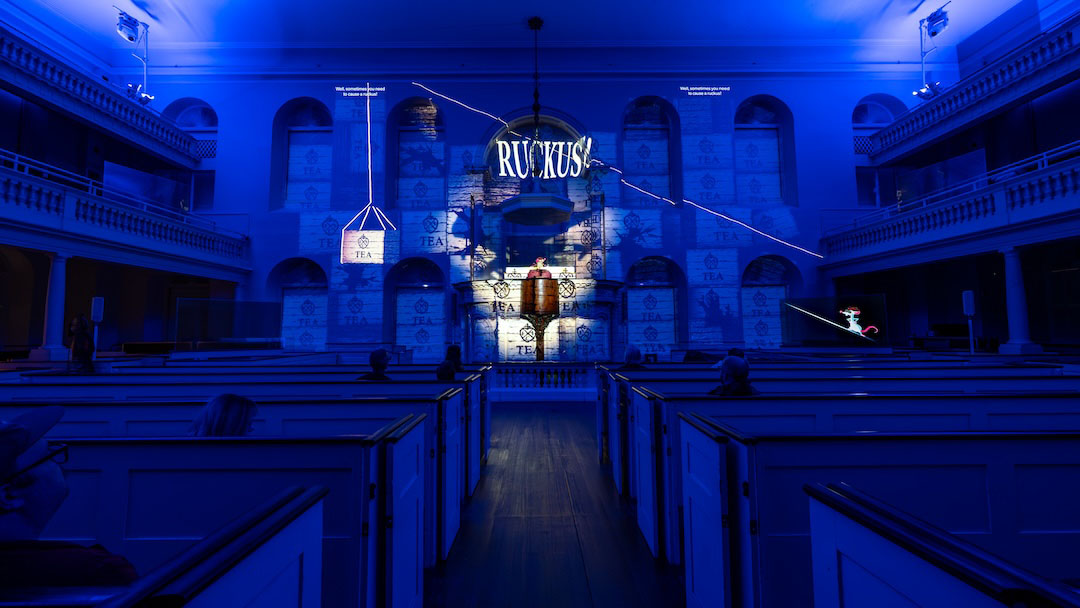
Electrosonic has delivered the audio system for Ruckus!, an experiential exhibit at Boston’s Old South Meeting House that places Revolutionary War history within a layered sound, lighting and projection environment.
Created by Revolutionary Spaces, the exhibit uses the historic venue’s architecture as an active part of the interpretation. Animated projections introduce figures connected with the revolutionary period, while recorded dialogue, sound effects and music build the atmosphere around seated audiences.
For museums, heritage operators and cultural attraction teams, the project demonstrates how audiovisual systems can be introduced into historically significant buildings without compromising architectural character. Old South Meeting House presents a familiar challenge for the sector: how to support contemporary interpretation inside a space originally designed for speech, assembly and civic debate rather than modern immersive media.
Low-Profile System Design For A Heritage Venue
Electrosonic worked with 1 Sound to create an audio solution that would deliver clarity, coverage and impact while remaining visually discreet. The brief required the system to serve the full audience area, including balcony positions, without drawing attention away from the building or projected storytelling.
The team selected 1 Sound Tower cardioid line array columns as the basis of the system. These were deployed through a configuration of mains, delays and fills to provide consistent coverage across the seated areas. The design supports the central show, while also giving the venue greater technical flexibility for forums, theatre, concerts and other live programming.
The main system uses Tower LCC84 loudspeakers, with Tower LCC44 units providing side fills. Flush-mounted Level L35 loudspeakers are positioned for surround fills across the room and toward the rear, while C4 loudspeakers extend coverage to the balcony. SUB28 subwoofers are placed at the front left and right of the space to support low-frequency content within the production.
This distributed multichannel design helps maintain a consistent listening experience across the main floor, surrounding seating and upper areas. For attraction designers and AV consultants, it offers a practical example of how careful loudspeaker selection and placement can address difficult room acoustics while respecting a protected interior.
Clarity As A Core Interpretive Requirement
Although projection and lighting form key visual components of Ruckus!, the audio system is central to audience comprehension. In heritage environments with reflective surfaces, high ceilings and irregular seating positions, spoken-word intelligibility can be difficult to achieve. That issue becomes more significant when a production relies on narration, character voices and layered sound effects.




Revolutionary Spaces had previously faced areas of poor speech clarity due to reverberation within the building. The new system was designed to improve intelligibility and maintain coherence across the room, rather than concentrating impact in a limited number of seats.
Senior interpretation lead Matthew Wilding has described the upgrade as a major improvement for both the exhibit and the venue’s wider programme. He noted that the system addresses the technical limitations of a historic setting while remaining largely unseen by visitors.
Lessons For Museums And Visitor Attractions
The Old South Meeting House installation points to a broader trend across the heritage and attractions sector. Operators are increasingly using immersive media to build deeper engagement with historical narratives, but these projects require technical strategies that suit sensitive buildings.
For B2B teams working in interpretive design, systems integration, museum planning and experience operations, the project highlights several commercial and operational priorities. These include early collaboration between content creators and technical partners, careful treatment of sightlines, coverage planning for non-standard room layouts and system flexibility for mixed programming.
Ruckus! also shows how investment in audio infrastructure can extend beyond a single exhibition. By improving speech clarity and coverage throughout the building, the venue gains a stronger platform for education, performance, public events and future media-led interpretation.
For heritage attractions seeking to bring historical content to modern audiences, the Boston project underlines the value of discreet technology that supports the story, the setting and the operational needs of the institution.


