
London’s Design Museum has opened Es Devlin: Other Worlds, the first European retrospective dedicated to multidisciplinary artist and designer Es Devlin, examining three decades of work across installation art, performance design and experiential environments.
Running from 2 October 2026 to 4 April 2027, the exhibition occupies the museum’s ground-floor gallery, combining archival materials, large-scale installations and immersive spatial design to examine Devlin’s creative development.
The exhibition provides insight into the processes behind her internationally recognised work, with particular attention to research, experimentation and the relationship between artistic ideas and their physical presentation.
For exhibition designers, museums and cultural experience developers, the retrospective demonstrates how personal archives and experiential environments can be integrated into a cohesive exhibition narrative.
Reconstructed Studio Provides Insight Into Creative Development
The exhibition begins with a detailed reconstruction of Devlin’s London studio, incorporating working models, books, drawing materials and equipment associated with her professional practice.
An introductory film, accompanied by Devlin’s narration, provides context for the creative processes and influences explored throughout the exhibition.
This opening environment establishes a connection between the working methods of a designer and the finished installations presented in subsequent galleries.
The reconstructed studio also demonstrates an interpretative approach that places research materials and production processes alongside completed artistic works.
Archival Displays Document Three Decades Of Design
A central component is the 30-Year Desk, a curved installation developed specifically for the retrospective.
The structure contains approximately 5,000 objects drawn from Devlin’s personal archive, including 30 rotating models, architectural maquettes, sketches and other materials documenting her professional development.
Complementing this installation are two displays titled The 50-Year Archive, Parts I and II, featuring drawings, paintings and sketchbooks that trace earlier artistic influences.
Together, these displays offer an extensive examination of the iterative processes involved in developing complex creative productions.
For design professionals and cultural institutions, the archival presentation provides a practical example of communicating creative methodology through physical objects and carefully organised exhibition environments.





Large-Scale Installations Demonstrate Experiential Exhibition Design
The exhibition incorporates several immersive installations associated with Devlin’s established artistic practice.
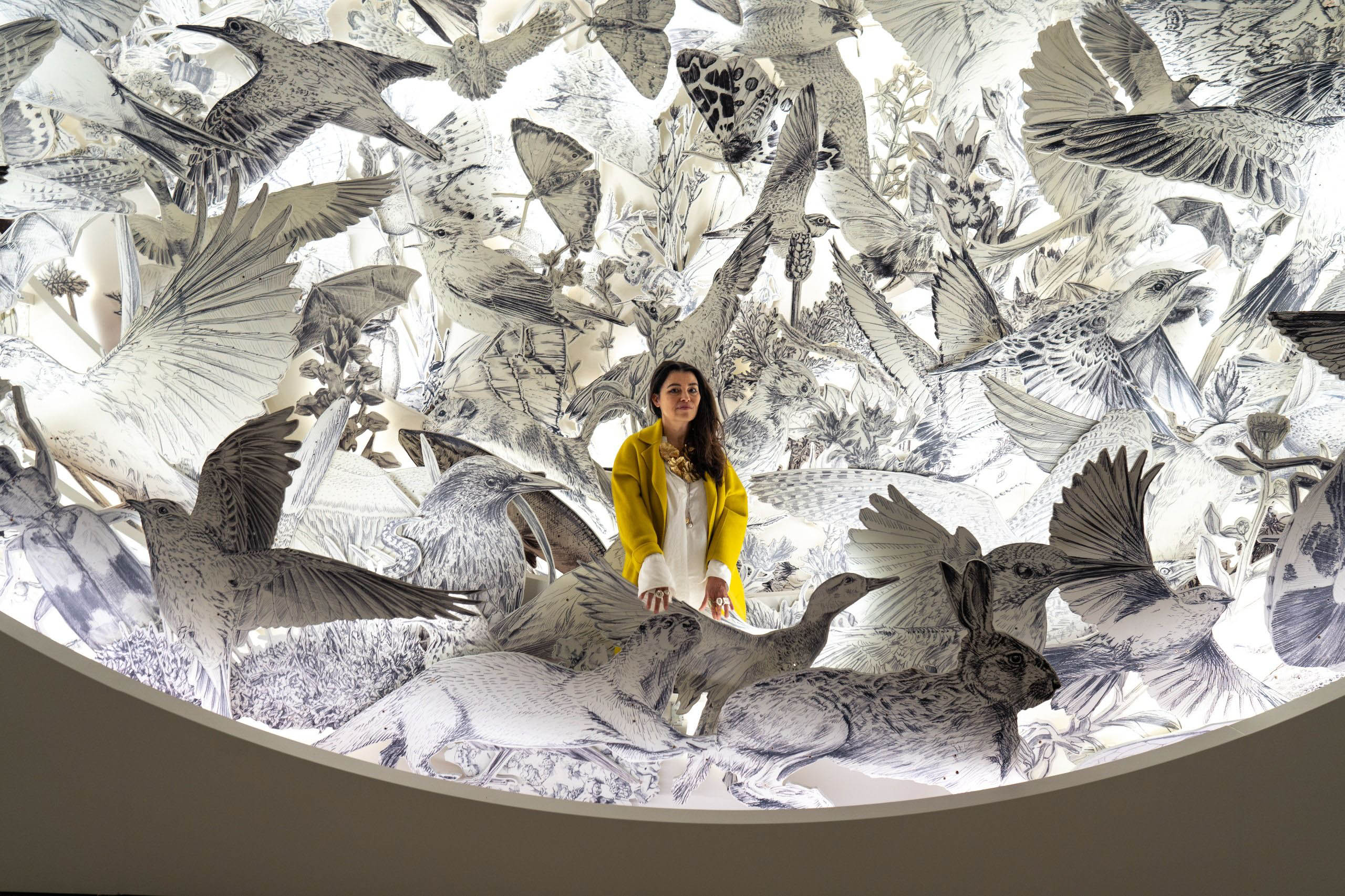
A mirrored gallery presents Come Home Again, an illuminated installation originally displayed at Tate Modern in 2022.
The work features illustrations of 240 animal species found in London, including mammals, insects, birds and fish, connecting environmental research with visual storytelling.
Reflective surfaces extend the installation’s perceived scale, demonstrating how scenographic techniques can influence spatial interpretation within gallery settings.
Elsewhere, a striking red passageway establishes a visual transition between exhibition sections, directing movement towards another major installation.
The Infinite Library occupies a mirrored platform and incorporates kinetic structures containing over 2,000 colour-organised books representing influences on Devlin’s artistic and intellectual development.
The installation combines movement, literature and spatial composition, providing a further example of how archival content can become an active component of exhibition design.
Exhibition Design Offers Insights For Cultural Experience Professionals
Developed in close collaboration with Devlin, the exhibition follows a deliberate progression from her working environment through archival research to large-scale installations. The Design Museum describes it as the largest solo presentation of her archive to date.
For museum operators, exhibition producers and experiential design studios, this structure illustrates how curatorial storytelling can connect creative processes with completed works.
The retrospective also highlights the use of reflective environments, kinetic displays and spatial transitions to organise complex exhibition content.
By presenting research, experimentation and finished installations within a unified visitor experience, Es Devlin: Other Worlds provides a valuable reference for cultural organisations developing immersive exhibitions that communicate both artistic outcomes and the methods behind their production.


