
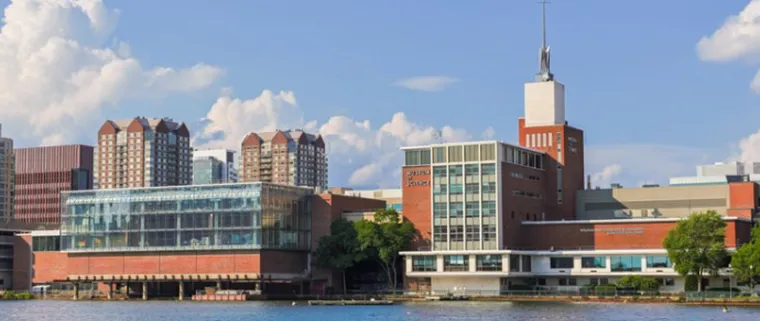
Boston’s Museum of Science is nearing completion on the William and Charlotte Bloomberg Public Science Common, a new 929 sq m venue designed by William Rawn Associates, Architects, Inc.
The glazed building is scheduled to open to the public on 10 October 2026, with a celebratory event planned for 28 October. Overlooking the Charles River and Boston skyline, the venue adds a major new public-facing space to one of the United States’ oldest science institutions.
For museum operators, science centres, architects and experienced designers, the project is notable for its flexible format and strong focus on civic dialogue. The building has been planned to support public conversation around science, technology and society, while also extending the museum’s reach through production and livestreaming systems.
Flexible Design For Multiple Programme Types
William Rawn Associates has designed the Public Science Common as an adaptable venue that can shift between education, debate, performance and media-led presentations. The practice’s previous work includes Seiji Ozawa Hall at Tanglewood, Cambridge Public Library and the renewal of Boston Public Library’s Central Library.
At the Museum of Science, the design uses movable walls and retractable seating to support different layouts throughout the day. The venue can operate as a roundtable setting, a school programme space, an evening event venue or a full performance environment.
This level of adaptability is commercially relevant for science centres and cultural venues. Buildings now need to accommodate education groups, specialist talks, public events, partner programming, funder activity and digital broadcast within the same footprint. By designing flexibility into the core architecture, the museum can widen its programming options without relying on a single use case.
Immersive Media Supports Science Communication
At the centre of the Public Science Common will be an immersive media environment designed for large-scale display, spatial sound and real-time data visualisation. Topics are expected to include artificial intelligence, climate change, public health and space exploration.


Ars Electronica’s Deep Space system will project ultra-high-resolution imagery across both floor and walls, creating an interactive environment for science content. Six movable LED video walls can be repositioned within the main room, giving the venue several display configurations for cinematic storytelling, live data and astronomy content.
The venue will also use d&b Soundscape spatial audio, giving designers and presenters the ability to place sound across a three-dimensional listening environment. Blackmagic 4K cameras and livestreaming technology will allow programmes to be broadcast in real time and made available on demand.
For B2B audiences, this combination of display, audio and broadcast infrastructure points to the direction of next-generation science engagement. It allows the museum to present complex subjects visually, host public discussion and reach audiences far beyond the building.
Science Centres As Public Dialogue Platforms
The programme for the Bloomberg Public Science Common will be announced before opening. Plans include daily museum activity, alongside special events involving scientists, creators and public figures. Robotics demonstrations and presentations on genetics, climate science and emerging technologies are also expected.
The project reflects a wider shift in museum planning, where science venues are being asked to act as public forums as well as exhibition spaces. Subjects such as AI, health, climate and space require formats that can support explanation, debate and live connection with experts.
For cultural planners and attraction operators, Boston’s new venue offers a clear case study in how architecture, media systems and programming strategy can work together. The Bloomberg Public Science Common positions the Museum of Science as both a physical destination and a broadcast-capable civic platform for science communication.


