
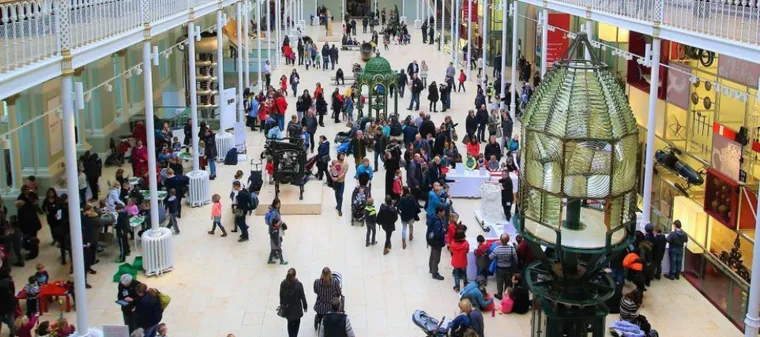
The National Museum of Scotland is set to host a significant new installation that examines the cultural and historical dimensions of science, forming a central component of this year’s Edinburgh Science Festival programme.
Commissioned by Edinburgh Science Festival, The Great Instauration is a large-scale work by artist Dr Gayle Chong Kwan that brings together sculpture, research and interpretation. Installed within the Grand Gallery, the piece responds directly to the legacy of the Scottish Enlightenment and its influence on scientific thought.
Rather than presenting science as a fixed body of knowledge, the installation examines how scientific understanding has been shaped by social, political and historical contexts. It draws attention to overlooked narratives, including Scotland’s links to slavery, the development of medical knowledge through botanical study, and the institutional role of the University of Edinburgh and early infirmaries.
For museums and cultural organisations, this approach reflects a broader shift towards interpretive frameworks that challenge established narratives and introduce more inclusive perspectives. It positions exhibitions as platforms for critical engagement rather than passive display.
Spatial Design And Interpretive Strategy
The installation adopts an inverted visual language, with sculptural elements suspended from architectural features within the gallery. Scientific instruments are reimagined as organic forms, while layered textiles reference Edinburgh’s geological structure. Steel plinths incorporate lesser-known historical accounts, adding a textual dimension to the physical environment.
This combination of suspended structures and grounded interpretation creates a multi-layered visitor experience. It demonstrates how exhibition design can integrate storytelling across spatial, material and textual elements without reliance on digital mediation.
For exhibition designers, the project offers a clear example of how historic collections and research can be translated into contemporary spatial experiences. It also highlights the potential of large civic spaces to support ambitious installations that engage with both scale and narrative depth.
Integration Within Festival Programming
The Great Instauration forms part of the wider Science Under the Lens exhibition, which expands on the installation’s themes through interactive and participatory elements. Visitors are invited to engage with scientific tools and concepts, linking historical inquiry with hands-on exploration.
Additional programmed events include specialist-led discussions and guided tours focused on the research and development process behind the installation. These formats extend the lifespan and relevance of the work, providing deeper engagement for professional audiences and sector stakeholders.




From a B2B perspective, this layered programming model illustrates how exhibitions can function as both cultural experiences and knowledge-sharing platforms. It also reinforces the value of aligning artistic commissions with broader thematic programming to maximise impact.
Cross-Sector Collaboration And Funding Model
The project has been developed through collaboration between multiple cultural and funding bodies, including Creative Scotland, the Henry Moore Foundation and several festival and museum partners. This model of shared support reflects the increasing complexity of delivering large-scale installations within the public sector.
Such partnerships enable the commissioning of ambitious work while distributing financial and operational responsibility. For organisations operating in the visitor experience sector, this approach offers a practical framework for delivering high-value projects within constrained budgets.
Edinburgh Science Festival, recognised as one of Europe’s leading science festivals, provides the wider context for the installation. Its 2026 theme focuses on science as a global, shared endeavour, reinforcing the relevance of projects that connect historical research with contemporary discourse.
Expanding The Role Of Cultural Institutions
The Great Instauration demonstrates how museums can operate as sites for critical reflection as well as exhibition. By combining academic research, artistic practice and public programming, the project aligns with a growing expectation for cultural institutions to address complex histories with clarity and depth.
For industry professionals, it provides a strong case study in how large-scale installations can support institutional objectives, contribute to festival ecosystems and engage audiences in meaningful ways without relying on conventional exhibition formats.


