
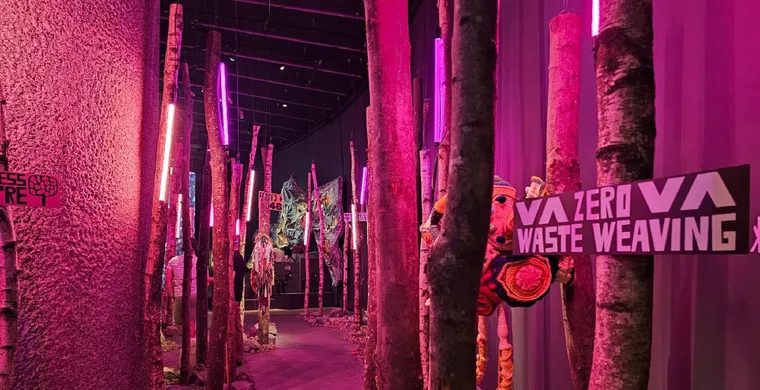
The Barbican Arts Centre is presenting In Other Worlds, a large-scale exhibition that uses speculative world-building to explore climate futures, rewilding and the possible shape of human settlement.
Staged across the Curve gallery and extending into the Barbican’s car park, the exhibition imagines a future in which the global population is concentrated within a single vast city, while the rest of the planet is left to recover through rewilding. The concept combines science fiction, environmental commentary and spatial installation, creating an atmospheric visitor route through a future shaped by carbon removal, dense urban living and ecological repair.
For cultural institutions, immersive producers and exhibition designers, the project offers a relevant example of how climate themes can be translated into physical and digital environments. It also raises useful questions around pacing, interpretive clarity and the balance between sensory design and curatorial substance.
Installation Design And Multi-Contributor Production
In Other Worlds is not presented as the work of a single artist. Instead, it brings together a broad group of contributors, resulting in an exhibition that operates as a collective speculative environment rather than a conventional solo display.
The exhibition includes sculptural elements, slow-moving video, headset-based content and walk-through environments. Among the more effective physical components are freestanding vertical clusters that suggest dense urban forms, alongside a forest-like passage that gives visitors a more tactile spatial encounter.
The use of the Curve gallery supports a gradual reveal, allowing the exhibition to unfold as a sequence of scenes. Extending the experience into the car park adds another layer, shifting the setting from gallery space to a more industrial backdrop. This spatial move is particularly relevant for venue teams considering how non-gallery areas can be used for narrative staging, especially in buildings with distinctive architecture.
However, the exhibition also points to a familiar challenge in immersive and installation-based work. Atmosphere can be powerful, but visitor engagement depends on rhythm, clarity and a sense of progression. Long-form video can support mood, but if pacing is too slow, audiences may disengage before the intended message develops.
Climate Messaging And Audience Response
The exhibition’s central idea considers a world where industrial systems are used to remove carbon from the atmosphere, while society is reorganised around extreme urban concentration. Its visual language draws on dense, dystopian city imagery, closer to science fiction than pastoral sustainability.




From a programming perspective, this creates a strong dramatic setting. It also places the exhibition within a wider cultural trend of climate-focused experiences that use speculative futures to make environmental risk more tangible.
Yet the project also demonstrates the difficulty of communicating climate issues without leaving audiences with a sense of fatigue. The car park section, which addresses how the imagined future might be reached, appears to lean towards warning rather than motivation. For institutions developing climate programming, this is a significant consideration. Audiences often need both urgency and agency, particularly when exhibitions address long-term planetary challenges.
More constructive framing around renewable energy, technological progress and practical transition could support deeper engagement. Hope, when handled with rigour, can be a useful interpretive tool rather than a softening device.
Lessons For Exhibition And Experience Teams
In Other Worlds is most effective as an atmospheric spatial encounter. Its strongest value for the visitor experience sector lies in its use of architecture, speculative design and environmental storytelling to create a distinctive setting.
For museums, galleries and immersive venues, the exhibition highlights several operational and creative lessons. Strong environments can draw audiences into complex subjects, but content pacing matters. Headset-based elements need careful queue management. Large contributor lists require clear curatorial framing. Climate narratives benefit from a balance of challenge, evidence and practical possibility.
Running at the Barbican Arts Centre until 6 September 2026, In Other Worlds adds to the growing field of climate-oriented cultural experiences. Its strengths and limitations make it a useful case study for organisations using immersive formats to address urgent global themes.


