
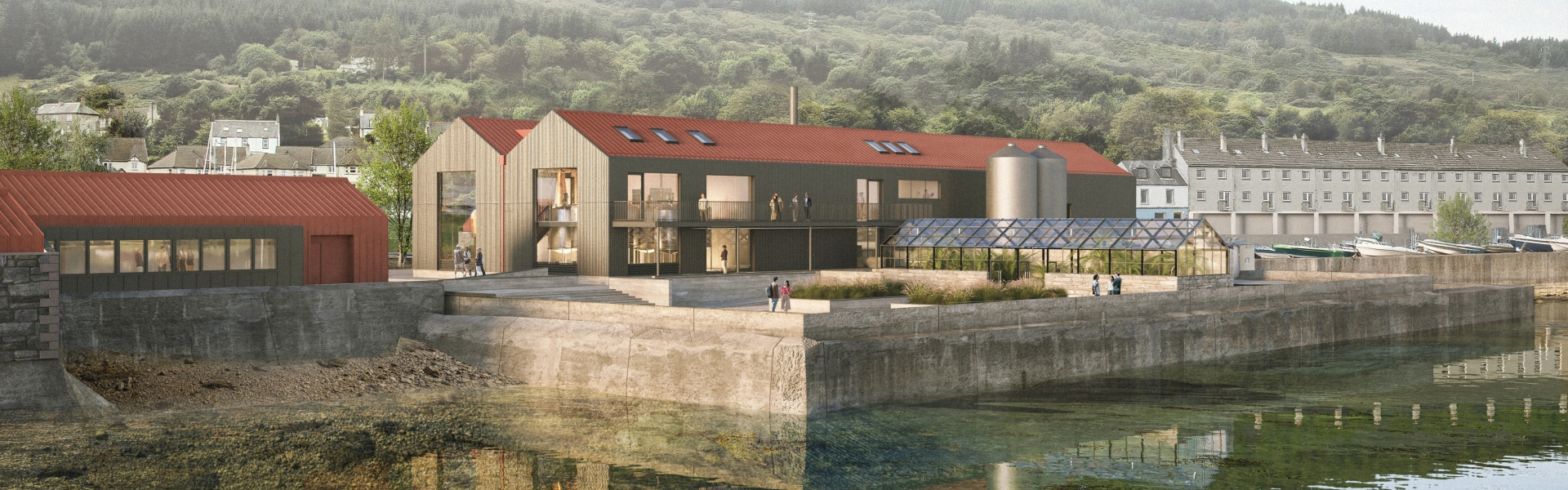
Argyll and Bute Council has granted planning permission for the £8.75m Ardrishaig Distillery, a new whisky production and visitor destination planned for a former oil depot on Scotland’s west coast.
The project, designed by Scottish firm Organic Architects, will be located at Loch Gilp and is expected to include a distillery, visitor centre, tasting rooms, viewing terrace and greenhouse. The planning application was approved on 25 September, allowing the scheme to move into its next development stage.
For destination planners, whisky tourism operators and heritage-led regeneration teams, the approval is significant. It will bring a productive new use to a difficult waterfront site while adding another visitor-facing asset to Ardrishaig and the wider Argyll tourism offer.
The site has been described as challenging and will require decontamination and extensive redevelopment before construction progresses. Completion is currently expected in late 2028.
Visitor Experience Built Into The Distillery Model
The Ardrishaig Distillery proposal reflects the increasingly experience-led nature of whisky development in Scotland. Modern distilleries are no longer planned only as production facilities. They are expected to serve as branded destinations, education spaces, tasting venues and anchors for local tourism.
The inclusion of a visitor centre, tasting rooms and viewing terrace points to a model where production and interpretation work together. Guests will be able to understand the process, the setting and the story behind the spirit, while the business gains opportunities for direct sales, hosted experiences and brand-building.
Ardrishaig Distillery founder John Moore has previously said the project is intended to create a site the village can take pride in, while also building a distillery known for both its whisky and visitor offer. His comments underline the role of design in communicating process, quality and place identity.
Regeneration Role For Ardrishaig Waterfront
The distillery forms part of a wider effort led by Moore to redevelop Ardrishaig’s historic waterfront. The former oil depot site has been difficult to bring back into use, making the planning approval an important step for local regeneration.
Organic Architects director Bari Reid has described the aim as giving people another reason to stop and spend time in Ardrishaig, while contributing to the village’s economic and social life. For B2B stakeholders, this illustrates how distillery projects can act as catalysts for smaller communities, particularly when located on underused or brownfield land.




The development also has heritage relevance. Once complete, Ardrishaig Distillery will be the first whisky producer in the village since Glenfyne Distillery, which was demolished in 1996. This gives the project an additional narrative layer, connecting new investment with local distilling history.
Wider Growth In Scottish Distillery Projects
The Ardrishaig approval comes amid continued activity in Scotland’s distillery development pipeline. In the past 12 months, several new projects have gained planning permission, including Glenachulish in Lochaber, Eyedent in East Lothian and Stock Spirits’ proposed site on the Inveraray Castle Estate.
This wider context is important for suppliers and consultants serving the visitor economy. New distillery projects can create demand across architecture, interpretation, exhibition design, hospitality, retail, landscape planning, lighting, AV, sustainability consultancy and operations planning.
The challenge for new entrants is differentiation. With Scotland’s whisky tourism sector already well established, new distilleries need a clear sense of place, a strong visitor journey and commercial spaces that support both brand storytelling and operational efficiency.
Relevance For Experience And Tourism Businesses
Ardrishaig Distillery offers a useful case study in the convergence of production, tourism and regeneration. Its approval shows how a challenging industrial site can be repositioned as a destination asset when planning, design and visitor experience are considered together.
For Experience UK’s audience, the project highlights opportunities in rural and coastal destination development, especially where hospitality, interpretation and adaptive site reuse are central to the business model.
As work advances towards a projected late-2028 completion, Ardrishaig Distillery will be watched as part of Scotland’s growing network of visitor-focused whisky developments and as a potential anchor for the renewal of Ardrishaig’s waterfront.


