
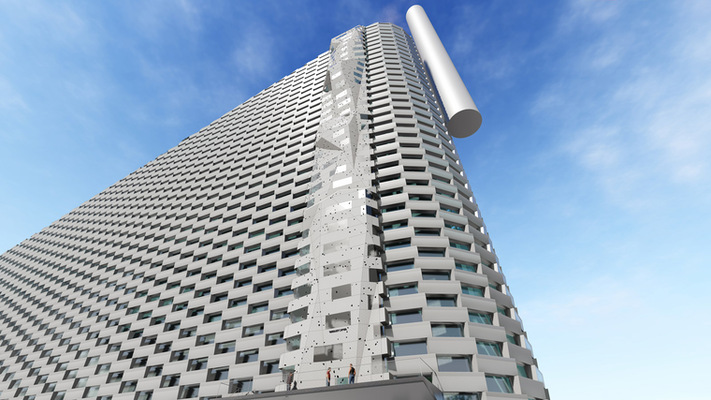
Danish architect, Bjarke Ingels’ Copenhill powerplant will soon feature the world’s tallest climbing wall. The sustainably designed Copenhill powerplant has long been a popular destination amongst thrill-seekers, with its ski slope bringing in visitors from around the world. Guests can now try their hand at another exciting pastime.
Standing at 85 metres, or 279 feet, tall, the new climbing wall is the largest phase of the Copenhill powerplant to open. “The climbing wall is located on the tallest corner of the waste-to-energy plant, which is also the busiest corner of the building where skiers, joggers, and workers all cross each other during the day,” says Jakob Lange, a partner at Bjarke Ingels Group (BIG).
The new climbing wall has been developed in partnership with Walltopia, a Bulgaria-based company that has created climbing structures in 70 countries around the world. BIG also sought input from professionals regarding climbing. “We teamed up with the Danish Climbing Association to ensure input from the most skilled climbers in the country,” Lange says.
As the tallest climbing wall in the world, the wall itself will attract thousands of visitors to Copenhill. However, the wall is designed to be in keeping with the building’s current aesthetic. “From BIG’s point of view, we wanted to create a climbing wall that was truly integrated into the architecture,” says Lange.




“The waste-to-energy plant’s façade is built from large aluminium bricks that allow daylight to enter the plant, and we, therefore, invented a semi-transparent climbing wall with two-thirds solid panels and one-third acrylic windows for the climbing route setters to integrate in their lines.”
The wall is split up into four sections, each with around 65 feet of climbing. “This is not a typical wall, says Vasil Sharlanov, head of sales at Walltopia. “For example, [normally] when you climb, you rely on the rope and belayer to protect you in case you fall. However, there isn’t a rope that’s long enough to climb such a high wall.” Climbers will have to stop at the ledge at the top of each section to rest and pull up the rope ready for the next climb.
The climbing wall was originally slated to open in spring of this year, however, the impact of COVID-19 caused a delay to the installation of routes and ropes, which were pushed back to June.


