
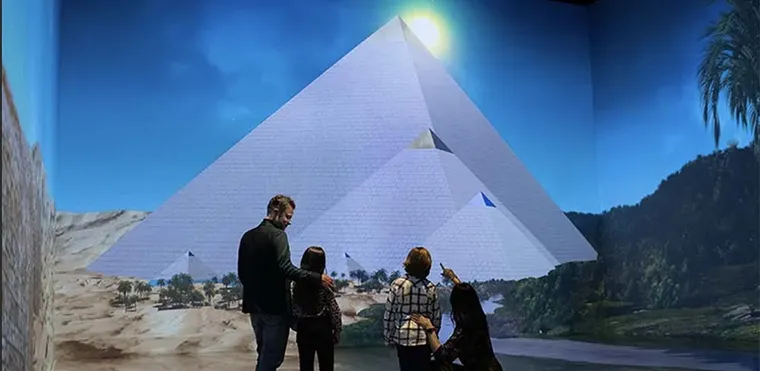
Tutankhamun: The Immersive Exhibition has opened at the NEC Campus in Birmingham, adding a major touring cultural production to the venue’s growing programme of experience-led events. The exhibition is being staged in Hall 11 for a 12-week run, closing on 13 September.
Spanning 2,000sqm, the production combines large-format projection, virtual reality, interactive media and museum-style interpretation to present the story of the Egyptian pharaoh Tutankhamun and archaeologist Howard Carter’s discovery of the tomb in 1922.
For venue operators, exhibition producers and cultural attraction specialists, the Birmingham run reflects continued demand for scalable, touring experiences that combine heritage content with digital presentation. The production has already reached more than 2.5 million visitors across previous runs in Madrid, Hamburg, Cairo, London, Glasgow and Stockholm, giving it a proven commercial and operational track record across multiple markets.
Heritage Interpretation Through Digital Media
The exhibition has been developed with input from Egyptologists and historians, giving the production a research-led basis alongside its technical format. This balance is increasingly important for cultural experiences that seek to engage broad audiences while maintaining credibility with education, heritage and museum-sector stakeholders.
A major feature of the production is one of the biggest immersive video-mapping rooms in Eurpope, where content is projected across surfaces reaching 8m in height. This allows the exhibition to present historic material at scale, using visual storytelling to support interpretation and audience attention.
The format also includes a 360-degree virtual reality component and an interactive digital recreation of the Valley of the Kings. These elements extend the exhibition beyond passive viewing and offer a model for how technology can be used to structure participation, orientation and subject exploration within a controlled visitor flow.
For suppliers and producers in the attractions sector, the project demonstrates how digital systems can be applied to heritage themes without relying solely on object-led display. It also shows the value of adaptable content formats that can be moved between major venues while retaining technical impact.
NEC Expands Its Consumer Experience Portfolio




The arrival of Tutankhamun: The Immersive Exhibition forms part of a wider push by the NEC Campus to bring more consumer-facing experience formats into its venue mix. Current and recent programming includes the Titanic Exhibition, Peppa Pig: Surprise Party and The Gladiators Experience, indicating a broad content strategy across entertainment, family brands and cultural subjects.
Sarah Harvey, deputy CEO of the NEC Group, has positioned the exhibition as a strong fit for the venue’s ambition to host high-profile experience content. The NEC has described its campus as the Nation’s Experience Capital, with the Tutankhamun production adding another international touring attraction to its summer calendar.
For large venues, this type of programming can support new revenue streams outside traditional trade shows, conferences and arena events. It can also increase campus utilisation, attract new audience segments and provide opportunities for partners across retail, food and beverage, transport and hospitality.
A Model For Scalable Cultural Experiences
The exhibition’s international performance and awards recognition, including three Telly Awards, point to the commercial potential of heritage-led immersive formats when supported by strong production values and clear narrative structure.
For the wider visitor experience industry, the Birmingham opening offers a further example of how cultural storytelling, digital production and venue infrastructure can combine within a touring model. As demand grows for content that is educational, visually rich and operationally repeatable, productions such as Tutankhamun are likely to remain attractive to major venues seeking flexible, high-capacity programming.


