
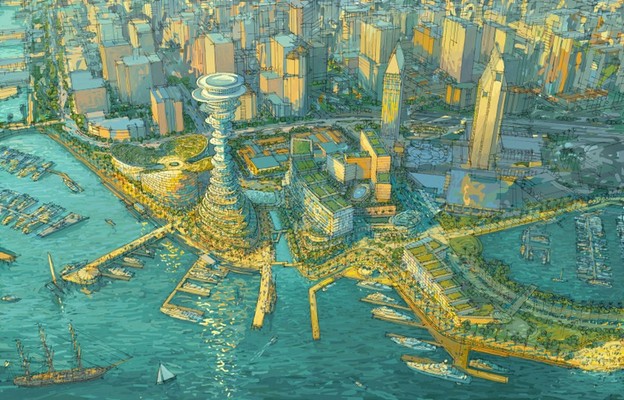
There is a growing sense among some circles that San Diego needs an internationally recognisable landmark of sorts; a destination that can cover the postcards and shout, “Visit me”.
The developers 1HWY1 seem to have just the right answer to such a calling. They proposed their idea of a landmark symbol for San Diego; a 500-foot tall tower at the downtowns waterfront, the Central Embarcadero. The cylinder-shaped tower, which is being presented as a modern replacement to the Seaport Village, is a unique design that is sure to capture attention from afar as well as serve as a distinguished landmark for San Diego.
The tower, which is still in the concept phase, makes up the highlighting feature of the colossal $2.4 billion Seaport San Diego project. The entire project will cover an expansive area of 70 acres along the harbour front. This will encompass both the land and the water areas within. There will be a total of over 2000 hotel rooms that will be spread across the 70-acre facility. 385 of these hotel rooms are proposed to be inside the base of the vertical hourglass tower. The proposed tower also includes a large aquarium covering an area of 170,822 square feet, an activity center, as well as office and retail spaces.
The developers behind the proposed project have already submitted the proposal to the permitting authorities, and the proposal will be screened and presented to the commissioners by the end of this month for initial approval.
The tower may be spectacular and unique in design and architecture, but there is vehement opposition to the project on a number of grounds.




Such a project is unprecedented across the waterfronts in California. Coastal constructions are subject to height restrictions; they can’t be taller than 30 feet under the 1976 Coastal Act that is part of the state legislature. The same legislation put the California Coastal Commission in charge of safeguarding public properties adjacent waterfronts.
Many opposing the construction believe that such a structure is in blatant violation of the coastal norms. The logic behind such an assertion is that high rise constructions across the waterfront hinder the public’s ability to see the coast and therefore this would set a negative precedent. Another concern stems from the fears that with such a lavish investment across the waterfront, the public place will no longer be a low-cost recreational area for the people.
The developers, 1HWY1, acknowledging these potential objections, are trying their best to allay most of their concerns. The public access will not be jeopardized they say, as over 70% of the area has been set aside for parks, walkways, and plazas in the blueprints for the construction.


