
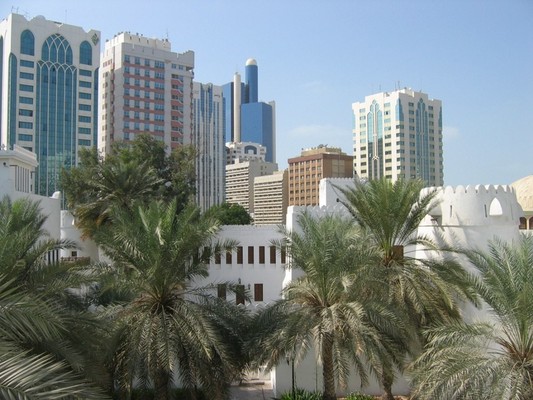
Qasr Al Hosn, the historic landmark of Abu Dhabi, opens its doors to the world after almost a decade. As Abu Dhabi’s oldest standing structure; Qasr Al Hosn has been the heart of the Emirati cultural heritage. Through time, the fort has stood as a living memorial of Abu Dhabi’s history. It has overseen the evolution of the island, from a small coastal settlement to a thriving metropolis that it is today.

Originally, the fort or ‘Hosn’ was a watchtower constructed from coral and sea stone, with the purpose of looking over the desert island’s most precious commodity – its only freshwater source. Sheikh Zayed of Al Nahyan recognised its strategic value and adopted the tower as the island’s seat of governance in 1855. Banking on the revenue generated from their first oil license; Sheikh Shakhbut bin Sultan commissioned the outer palace in 1939. Whereas, Sheikh Zayed bin Sultan developed it into a Majlis and a home for the Al Nahyan family. The building was further established as the National Consultative Council which hosted the negotiations to unify the emirates as a collective entity. In 2008, the fort was closed for extensive restoration and was reopened in December 2018 as a museum.
British based museum designers, hsd was appointed by the Department of Culture and Tourisum (DCT) with a brief to create a new museum fit for the 21st century, through a mix of audio visual, artefacts and interactives which tell the story of the city, people and heritage.
To have been given the opportunity to work on such a historically significant building has been a real privilege for the team at hsd” said Jan Faulkner, Director and Designer at hsd, “We have created a multi-layered experience to give visitors an accurate idea of what it was like living and working in and around the Fort. By mixing traditional with digital media the Fort has been brought back to life and visitors are really immersed through sound, imagery and dynamic interactives.”

After its inauguration as a museum, with the fit-out completed by UK based museum specialists BECK, the fort has become a year-round destination for travellers from across the world. The museum is home to archival material, archaeological objects and interactive audio-visual experiences, created by DJ Willrich, that narrate the history of the city’s evolution from a coastal settlement to an international hub.




The museum hosts several tourist attractions such as the residence of the royal family. The rooms have been re-enacted so that people can study the lives of the men and women who have ruled this part of the world.

Emirati people are generous and eager to teach the rest of the world about their customs and traditions. Thus, they have set up a House of Artisans to host workshops and demonstrations that teach traditional crafts such as Al Sadu weaving, Tote Printmaking and many more unique indulgences. The House also hosts UAE’s first Bait Al Gahwa, a step which encourages visitors to experience the hereditary beverage of Arabian coffee.
The most exciting feature of the museum is the Cultural Foundation. The Cultural Foundation adorns a range of invaluable art crafted by Emirati artists. These artefacts embody the skilfulness, creativity and distinction that the regional artists possess. Moreover, the complex contains a Visual Arts Centre that comprises of art studios exhibition galleries, lecture halls and screening rooms. They also plan to add a 900-seat amphitheatre along with a children’s library. This establishment will be the first of its kind in this region and will encourage children to engage in extra-curricular activities.
The Visual Art Centre will also organize an exhibition of contemporary Emirati art. It is a step to honour the vision of Sheikh Zayed bin Sultan Al Nahyan who had conceptualized the Cultural Foundation. It was his initiative that provided space to the Emirati intelligentsia to exhibit their passion for poetry, arts and crafts.
Our legacy is what remains after we cease to exist. For the Emirati people, Qasr Al Hosn stands as a symbol of their legacy; an embodiment of grace and a testament to their rich history.


