
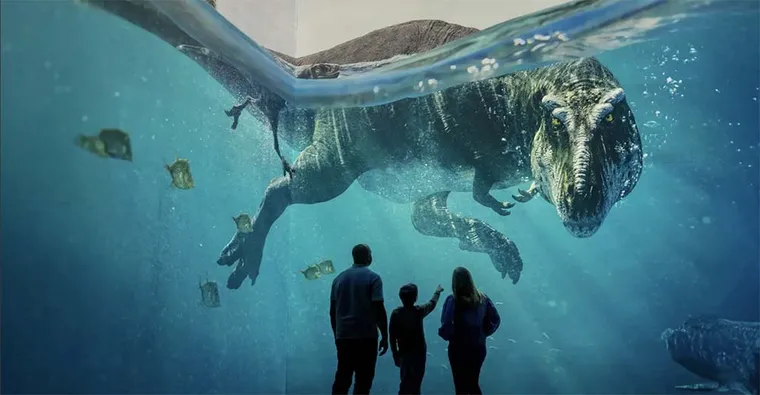
Factory International has confirmed that Prehistoric Planet: Discovering Dinosaurs will open in Manchester later this year, adding a major new immersive production to the city’s growing cultural and experience economy.
The exhibition is the latest Lightroom experience to be announced for Manchester and follows the recent release of Factory International’s autumn and winter programme. Built around Apple TV’s Emmy-nominated Prehistoric Planet, the production will combine recognised screen content with new material created for a 360° environment.
For operators, cultural venues and experience designers, the project signals the continued commercial and creative value of premium factual entertainment within immersive formats. The production brings together natural history storytelling, large-scale projection, spatial sound and extended digital sequences, giving venue teams a format that can appeal across education, culture and leisure markets while retaining a strong editorial foundation.
Established Intellectual Property Meets Immersive Production
Prehistoric Planet: Discovering Dinosaurs draws on selected moments from the first two seasons of Apple TV’s Prehistoric Planet, while also introducing new CGI sequences and bespoke illustrations created specifically for the exhibition format.
The experience is narrated by actor Damian Lewis, who guides the story across prehistoric life, from Ammonites and Mosasaurs to the Tyrannosaurus rex. The content is designed to place audiences within environments dating back 66 million years, using scale and movement to present extinct species in a format beyond traditional screen viewing.
From a B2B perspective, the use of established intellectual property is significant. Recognisable content can support audience development and marketing activity, while the addition of exclusive exhibition material gives the production a distinct reason to exist as a physical experience. This model is increasingly relevant for venues seeking content that can connect entertainment, education and repeatable ticketed programming.
Technology Supporting Natural History Interpretation
Lightroom’s 360° projection format will allow prehistoric environments to surround visitors, with sequences set across volcanic terrain, open skies and deep-sea settings. The production uses large-scale imagery to communicate the size, behaviour and ecological role of prehistoric animals in a way that can be understood visually and spatially.




The exhibition also features an original soundtrack by Kara Talve, Anže Rozman and Hans Zimmer for Bleeding Fingers Music. For immersive experience producers, the role of music and sound is central to pacing, emotional response and audience focus. In this case, the audio treatment supports the educational narrative while giving the project the feel of a premium cultural presentation.
This type of production demonstrates how natural history content can be adapted for immersive venues without losing its learning value. By combining scientific themes with cinematic presentation, Prehistoric Planet: Discovering Dinosaurs offers a format suited to audiences with differing levels of subject knowledge, from school and family groups to general cultural visitors.
Manchester’s Growing Immersive Programme
The dinosaur exhibition will join David Bowie: You’re Not Alone, another previously announced Lightroom production for Manchester. Together, the projects point to a broader programming strategy that uses globally recognised subjects to build a varied immersive calendar.
For Factory International and its partners, this approach supports Manchester’s position as a destination for large-scale cultural experiences. It also shows how venues can use immersive formats to broaden their programme across music, natural history, screen content and education-led storytelling.
For the wider visitor experience sector, Prehistoric Planet: Discovering Dinosaurs offers a useful case study in adapting high-quality media properties for physical environments. Its combination of branded content, new digital production and venue-scale presentation reflects a maturing market, where immersive exhibitions are being developed as structured cultural products rather than temporary visual spectacles.


