
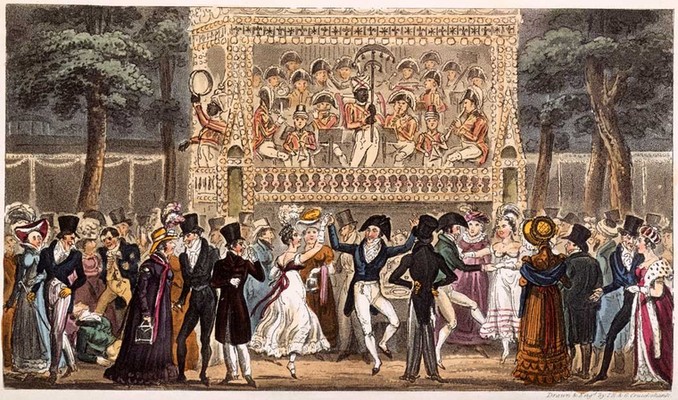
“Part art gallery, part fashion show, part brothel.” That’s how the famous Vauxhall pleasure garden was described. A place where people from any background, could come together to explore contemporary art and new music, alongside the latest scientific thinking and technology.
Our fashions, our thinking, the tools we use to create and share, have all evolved, yet our desire to connect, to be seen, to learn, is unchanged. In 2020, the pleasure garden offers us a place to reawaken our relationships with each other and the environment around us, a place where we can find meaning, make new discoveries and establish a new sense of community.
You can trace the impact of the pleasure garden through the centuries. From their inception in Ancient Rome, they have been a place where people came together to socialise, eat, spend time in nature, listen to music and experience art and technology. They dominated London’s entertainment scene throughout the 18th and 19th centuries and laid the foundations for many of the world’s most famous attractions. From Denmark’s Tivoli Gardens and Disney’s theme parks, to World Expos and Olympic Opening Ceremonies, their influence, the desire to dazzle and create spectacle can be felt.

One of the most famous is the Vauxhall Pleasure Garden, which traces its beginnings to 1660. Known then as Spring Gardens, people gathered for refreshments. In 1729, Jonathan Tyers established it as the home for leading contemporary artists such as Handel and Hogarth. It evolved into the Vauxhall Gardens, drawing enormous crowds to see its tightrope walkers, hot-air balloon ascents, fireworks and concerts. Oh, and lovers who used its manicured gardens and pathways for romantic trysts.
The concept of a fixed amusement park developed further with the World Fairs. Starting in 1851 with the landmark Crystal Palace, where industrial achievement of the nations of the world was celebrated, whilst both educating and entertaining visitors.

The pleasure garden was the place where Londoners confronted their very best and worst selves. It was a break from the mundane, a unique mix of glittering wealth, fashion and high culture alongside the city’s seedy underbelly. A place where princes partied with prostitutes and the middle classes went to be shocked and titillated by the excesses on display. A great part of the entertainment was offered by the well-dressed attendees themselves. Pauses between pieces of music were intentionally long enough to give the crowd time to circulate the gardens anew.
The pleasure garden gave visitors the opportunity to be part of tomorrow’s world; it was where cutting-edge technology was showcased, where the day’s artists, scientists and creators could push boundaries and test their latest thinking.




Notable creations include the Display of Paintings in Vauxhall, an experience for those in the supper-boxes, whose sides unfolded out of the earth at dusk, to enclose the space with “a numerous collection of grand and pleasing paintings”. At Coney Island the invention of incubators for new-borns was shared, elsewhere it was illuminations, fireworks and hot-air balloons that wowed the crowds.
We have the same need today, to be inspired, to mix socially, and to bounce ideas off one another. Our challenge now is how to harness digital technology, social media and mass observation techniques for good.
I believe the modern pleasure garden can be a space where we can learn from the brilliance of our differences and create a shared sense of stewardship for the world around us. If we fully engage our human senses, if we learn, test, play together, we may discover the solution to our world’s future and have time to reshape our behaviour.

I’m inspired by the EDEN Project and Gardens by the Bay for their sustainability and Banky’s Dismaland for its critique of contemporary culture. At the Garden of Ideas we’ll take it further. Immersive experiences will remind us to value the real world. Food won’t just be eaten, but tasted as you take a dark ride through the world’s largest vending machine. We’ll tell stories that matter through collaborations with ROH and Shakespeare’s Globe. We’ll move the virtual to reality, taking the best Minecraft creations and video-mapping them onto an installation piece. Or take you on trip through your own history, as Chris Milk’s Wilderness Downtown video explores.
In our politically polarised times, we need to bring people together in fresh and inspirational ways, as the early gardens did. As sports bring opposing teams together, so do arts and culture. In the pleasure garden of the future, I see people from all walks of life, drawn by the power of storytelling, the allure of the unknown and the chance at a new encounter. They learn science and agree facts, separate gossip from fake news. They become informed and trusting of difference and grow stronger together to better serve the planet and all its wonderous living things.

Written by Simon Elliott, CEO and Creative Director, Garden of Ideas UK, China and Canada


