
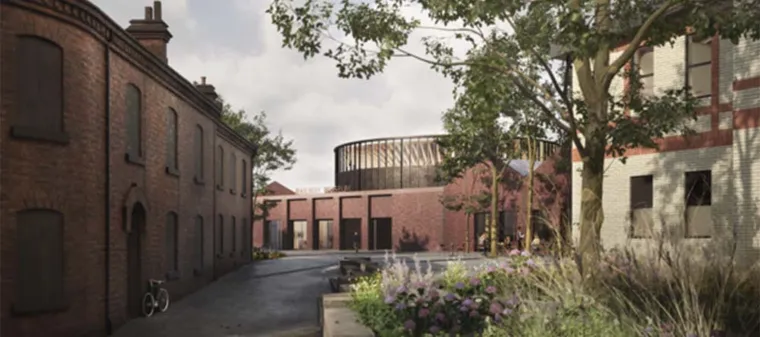
The National Railway Museum’s Central Hall project has received a £3m in additional funding, allowing construction to begin next month and moving forward a long-planned scheme to connect the museum’s York site.
The funding was announced by Prime Minister Keir Starmer during a visit to the Science Museum Group site. The support will allow the museum to sign its main construction contract shortly, following earlier backing from the Department for Culture, Media and Sport.
Central Hall will create a new building at the centre of the museum, improving level access across the site and providing a new interactive gallery, Railway Futures: The Porterbrook Gallery.
A New Civic And Visitor Experience Asset
Designed by Feilden Fowles, the circular building references historic railway roundhouses. Plans include recycled copper cladding, high glazed ceilings and timber radial structures.
The project gained planning permission in 2022, after initial DCMS funding in 2019 and the appointment of the design team in 2020. Although the original 2020 budget was £16.5m, project costs may have shifted due to wider construction market pressures.
For museum planners, architects, interpretation specialists and access consultants, Central Hall is a relevant example of how cultural institutions are using capital projects to address circulation, inclusion, future-facing content and site identity.
The scheme also forms part of York Central, a 45-hectare brownfield regeneration project set to create homes, civic space and commercial development on underused railway land.
Liverpool Waterfront Receives £19m Investment
Further public funding has also been confirmed for National Museums Liverpool, with DCMS Public Bodies Infrastructure Fund’s £19m allocated to the Maritime Museum and the International Slavery Museum.




The investment supports the Waterfront Transformation Project, which covers the area between Mann Island and Royal Albert Dock. The redevelopment will focus on heritage, storytelling, community use and improved connections across the waterfront.
Feilden Clegg Bradley Studios is leading the architectural work, which includes a new entrance for the International Slavery Museum and a link bridge between two buildings with views across the docks. The Maritime Museum entrance and internal spaces will also be updated.
Ralph Appelbaum Associates is leading exhibition design for both museums, with new galleries and shared facilities planned for learning, research, events and community activity.
Capital Projects With Sector-Wide Value
Both announcements point to the continuing role of public investment in museum renewal, regional regeneration and visitor economy growth.
For the wider experience sector, the York and Liverpool schemes create opportunities across architecture, exhibition design, AV, accessibility, public realm planning, fit-out, heritage interpretation and operational planning.
They also show how museums are increasingly being asked to deliver broader civic value. These projects are not only about new galleries or improved buildings. They are also tied to regeneration, community participation, future skills, tourism and local economic activity.
For Experience UK members and suppliers, the funding signals continued demand for specialist expertise that can connect heritage, design, technology and public engagement within complex cultural sites.


