
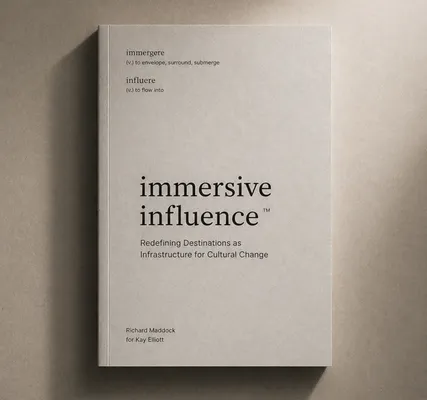
We are pleased to share the publication of Immersive Influence, a new whitepaper by Kay Elliott Director Richard Maddock, launched at WXO London Experience Week in April 2026.
Presented to an international audience of experience economy operators, designers and thinkers, the paper explores a question we believe is becoming increasingly important for our sector: what if the places people visit for escape could also help address the wider pressures shaping the world around us?
At Kay Elliott, our work is rooted in the design of places that bring people together. Through Immersive Influence, we examine how experiential destinations can play a more active role in shaping attitudes, behaviours and culture.
Rethinking The Role Of Experience
Immersive Influence argues that experiential destinations occupy a unique position. They bring together high-value economic activity, strong emotional engagement and the shared environments through which cultural ideas often spread.
The paper draws on three areas of thought: Pine and Gilmore’s work on experiences and personal change, Donella Meadows’ thinking on paradigm shift as a deep point of systemic change, and evolutionary anthropology’s view of shared embodied experience as a key driver of cultural transmission.
For us, the importance lies in their convergence. Attractions, immersive destinations and location-based experiences can reach audiences emotionally, socially and physically, often at significant scale.
That gives the sector influence. It also gives it responsibility.
Designing With Greater Intention
The location-based entertainment sector is projected to grow from $4.5 billion in 2023 to more than $73 billion by 2034. As this growth continues, we believe the industry must consider not only what it creates, but what its creations encourage, normalise and communicate.
Immersive Influence makes the case that these destinations are already shaping culture. The next step is to design that influence with greater purpose.
This does not mean removing entertainment value. It means recognising that memorable experiences can carry meaning, prompt reflection and support positive change while still meeting commercial and operational goals.



A Cross-Sector Conversation
Since launch, the response to Immersive Influence has come from across experience design, technology, academia and government. This breadth of interest reflects one of the paper’s central points: the role of experiential destinations is not limited to one part of the market.
The ideas explored in the whitepaper are relevant to theme parks, visitor attractions, immersive environments, cultural destinations, brand experiences and future-facing public spaces.
We have also been encouraged by responses from leading voices in the experience economy. James Wallman, CEO of the World Experience Organization, has recognised the paper’s contribution to the discussion around immersive destinations as forces for positive change.
B. Joseph Pine II, author of The Experience Economy and The Transformation Economy, has also responded to the paper’s focus on intention, noting the importance of how businesses choose to use the influence that experiences already hold.
Looking Ahead
For Kay Elliott, Immersive Influence is part of a wider conversation about the future of experience-led design.
We believe the places people visit for escape already have the potential to help address some of the challenges shaping society. The key question is how deliberately the sector chooses to design for that potential.
Immersive Influence is available to download at:
https://kayelliott.co.uk/immersive-influence


