
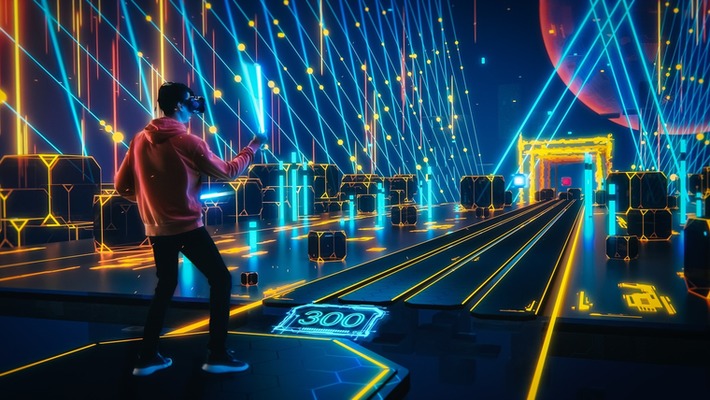
The immersive media market is currently undergoing an unprecedented expansion, forecasted to rocket to a staggering US$178.7 Billion by the year 2032. With a Compound Annual Growth Rate (CAGR) of 22.3%, this burgeoning sector symbolises the converging tide of digital technologies aiming to captivate users within multi-sensory, deeply engaging environments. Spanning from virtual reality (VR) to augmented reality (AR), mixed reality (MR), and 360-degree media, immersive media technologies are increasingly sought after in entertainment, education, healthcare, and retail domains, amongst others.
This robust market is propelled by the surge in VR and AR device popularity, the incorporation of immersive tech in corporate training and learning environments, and by the fact that immersive technology has become more accessible through more affordable hardware, advanced software, and integration with ubiquitous smartphones.
Market Composition and Projections
The composition of the immersive media market is dominated by hardware, holding a 53.6% share, with sophisticated processors, GPUs, and display technologies crucial for delivering rich sensory experiences. Notably, VR technology claims the largest market share due to its unmatched capability for immersion into alternate realities, providing multifaceted benefits from entertainment to healthcare applications.
The transformative power of immersive media is most prominently displayed in the training and learning space. Commanding a 38.4% market segment, these applications are revolutionising training methods, offering realistic simulations that foster skill development in various domains.
The figures speak volumes: the augmented reality and virtual reality market size is predicted to reach approximately US$106.2 Billion by 2033, showcasing growth from US$34.8 Billion in 2023. Similarly, the extended reality (XR) market size is expected to explode to around US$519.5 Billion by 2032 from a current value of US$49.6 Billion, indicating the sector’s vast potential and the appetite for these technologies.
Sector-Specific Growth and Integration
The impact of immersive media on various sectors is profound. By 2023, 25% of organisations are predicted to adopt immersive media for employee training, doubling from the previous year. Customer engagement is also expected to double to 30% of organisations using these technologies, indicating the centrality of immersive experiences in maintaining competitive edge and customer loyalty.
In healthcare, the forecast is for immersive media to capture a ~17% market share in 2023 alone, demonstrating its effectiveness in medical training and patient care. Retail and e-commerce are not far behind, with an anticipated 13% market share, as AR and VR redefine the shopping experience with virtual try-ons and product visualisations.
With the advent of 5G technology, a new era of immersive media applications is on the horizon, allowing for low-latency, high-bandwidth experiences. Manufacturing is also embracing this wave of innovation, with an expected market share of ~11.2% as the industry harnesses AR and VR for training, design, and remote assistance.
 A chart depicting the anticipated growth of the Global Immersive Media Market” – Courtesy of Market.US




Trends Shaping the Future
The trends emerging within immersive media point towards a transformative future for technology and industry sectors. Extended Reality (XR) is paving the way for a blend of virtual environments that promise to enhance user engagement across various platforms. Social VR platforms and virtual worlds are fostering new forms of online interaction and community building whilst immersive learning and training utilise these media to improve educational outcomes.
Retail and commerce are undergoing a revolution with immersive media at the helm, providing customers with a dynamic shopping experience. The healthcare industry is equally benefiting from these technologies, with applications ranging from therapy to surgical planning.
Use Cases Demonstrating Impact
Across numerous sectors, the use cases of immersive media are as varied as they are impactful. Organisations leverage VR and AR for realistic and safe training environments, especially in high-stakes fields such as aviation and healthcare. Remote collaboration and virtual meetings have taken a new turn, with teams now able to meet in virtual spaces, boosting productivity and engagement.
Customer engagement has been transformed by immersive marketing campaigns, while the education sector benefits from virtual field trips and simulations. In healthcare, VR aids in patient therapy and training for medical procedures. For retail and e-commerce, immersive media has bridged the gap between physical and online shopping experiences. In real estate, VR tours offer unprecedented convenience for potential buyers.
Industry Movement and Innovation
Key industry players like Microsoft, Meta (formerly Facebook), Sony, and Epic Games are leading the charge, with significant developments such as Microsoft’s acquisition of Activision Blizzard, the release of Meta Quest Pro, Sony’s PlayStation VR2, and Epic Games’ partnership with Lego. Qualcomm’s introduction of the Snapdragon XR2 Gen 2 chip is set to further enhance the performance of immersive media devices.
Conclusion
In sum, the immersive media market represents a sector on the cusp of a technological renaissance driven by consumer demand and the quest for enhanced experiential engagement. The forecasted market size of US$178.7 Billion by 2032 underscores the escalating importance and potential of immersive technologies, which stand to redefine how we interact, learn, and experience the world around us.


