
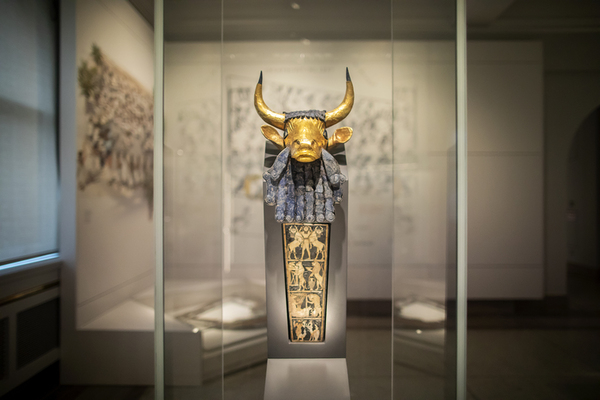
NEW Middle East Galleries at the Penn Museum in Philadelphia, designed by hsd, opened with a lively Weekend Festival on 21 and 22 April. These striking galleries represent the first phase of the most significant refurbishment of the Penn Museum in 118 years.
Founded in 1887, the Penn Museum was the first United States institution to send an archaeological expedition to the Middle East. More than 130 years and hundreds of international expeditions later, the Museum remains a world leader in Near Eastern archaeology, with a collection of more than 100,000 historically-significant artefacts. Ten curators with wide-ranging expertise in the region contributed to the selection of artefacts and the rich storyline that emerged during a multi-year development process.
Set in 6,000 square feet of recently renovated gallery space, the Middle East Galleries are the first of the Museum’s upcoming signature galleries to open. This suite of galleries invites the visitor to travel on a remarkable 10,000-year human journey ‘to the city’ – from life in the earliest villages and towns to increasingly complex and large-scale settlements.
hsd’s approach to the Middle East Galleries has been one of analysis and exploration. Analysis of the brief, the collection, the building and audience, developed alongside explorations of potential arrangements, themes and media, and exploration through sketches, photos, models, diagrams and images, to shape an understanding of the potential within the large collection.
“Our technical and creative design approach took the physical setting of the galleries into account”, comments Alisdair Hinshelwood, Designer and Director at hsd. “Our design optimises visitor flow and routing for both access and gallery users, stylistically acknowledging the historic character of the spaces, whilst offering an attractive and inviting gallery environment.”
Walking through the gallery, links between past people’s lives, contemporary society and challenges will become clear to visitors – encouraging an appreciation of fundamental aspects of our culture and society today that originated in the Middle East.




Nearly 1,200 objects from the Museum’s collections are on view. These include world-renowned treasures such as a Sumerian queen’s crowning jewellery from 4,500 years ago, the famed Ram-in-the-Thicket statuette, and one of the oldest known wine vessels in the world. The objects are the prime means of communication, enabling visitors to explore the wider social, cultural, commercial, artistic and political context in which these items were produced.
Large-scale video projections, scale models, illustrator’s renderings of scenes from the reconstructed past, smaller interactive stations, and touchable reproductions provide diverse avenues for visitors to explore the collections and the stories they tell.
Alisdair continues, “The Middle East Galleries was designed to appeal to a broad spectrum of visitors, from ‘professional’ audiences and those with a keen interest in the subject, to families and school students.”
Initial reviews from private viewings prior to the opening weekend have been hugely positive, with many people commenting on how the design approach and installation allows visitors to fully appreciate the breath-taking collections.
hsd is currently working on numerous cultural and heritage projects including the National Air and Space Museum in Washington D.C., the Museum at the Gateway Arch, St. Louis, United States, and the Museum of Royal Worcester, UK.


