
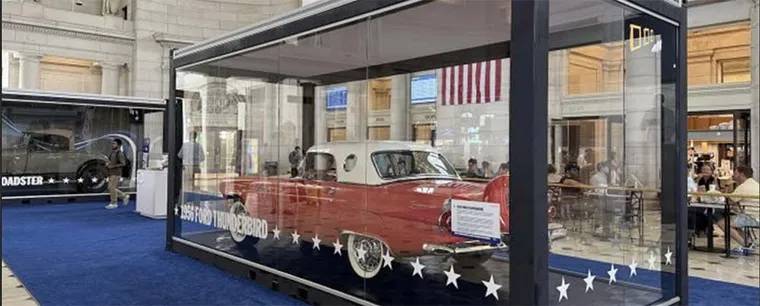
Ford has partnered with experience design agency Imagination to launch Driving America Forward, a two-week public exhibition at Union Station in Washington DC.
The experience runs until 14 July 2026, aligning with America 250 celebrations and placing Ford’s automotive heritage within one of the capital’s major transport and civic settings. The exhibition uses Union Station’s main hall to present ten vehicles from the Ford Heritage Fleet, each housed in museum-style glass displays.
For brand experience agencies, automotive groups, cultural programmers and destination partners, the project shows how heritage collections can be adapted for high-footfall public environments. Rather than relying on a conventional showroom or museum location, Ford is using a landmark station to connect automotive history with national commemoration, daily commuter movement and civic visibility.
The exhibition is organised around themes including Shaping Pop Culture, American Innovations and 125 Years of Racing. This gives the vehicle collection a clearer interpretive structure and allows the brand to communicate its role across culture, manufacturing, mobility, competition and public service.
Historic Vehicles And Interactive Interpretation
Driving America Forward presents vehicles and objects that span more than a century of Ford’s development. The display includes rare artefacts connected to the company’s technical progress, racing history, wartime activity and humanitarian work.
For visitor experience professionals, the curatorial approach is notable because it links product heritage with broader social and cultural context. Automotive exhibitions can risk becoming object-led displays aimed only at marque enthusiasts. Here, the thematic structure is intended to connect the vehicles to wider American stories, making the content more accessible for a mixed public audience moving through a transport setting.
The exhibition also includes several interactive touchpoints designed to increase engagement in a short dwell-time environment. A photo postcard activation allows visitors to create a personalised Union Station image with Ford branding, combining a physical takeaway with a digital sharing asset.
A large LED screen operates as a digital gallery, adding a future-facing layer to the heritage display. QR codes provide access to bespoke content linked to the vehicles and artefacts, allowing visitors to explore further information without overloading the physical exhibition space.
Designing For High-Footfall Public Settings
Union Station’s heavy footfall creates both opportunity and design challenge. The experience must attract attention quickly, support self-guided exploration and remain legible for visitors who may not have planned to attend an exhibition.



Imagination’s team has approached the project as an invitation to pause and interact, using bold visual elements, clear thematic groupings and digital layers to support engagement. Ford Brand Ambassadors are also present during daily exhibition hours to welcome visitors, distribute exclusive merchandise and provide further context around the displays.
For operators and agencies, this staffing element is important. In public-facing brand exhibitions, ambassadors can help bridge the gap between passive display and active engagement. They also support crowd flow, answer questions and reinforce the brand narrative in a more personal way.
The use of glass display cases, large-format graphics, digital screens and quick-response content shows how temporary exhibitions can be built to meet the practical conditions of public infrastructure sites while still delivering a polished brand experience.
Value For Brand Experience And Cultural Partnerships
Driving America Forward offers a useful case study in how companies can activate milestone anniversaries through public heritage programming. By aligning with America 250, Ford is placing its brand story within a wider national moment rather than presenting a standalone marketing event.
The partnership with Imagination also highlights the role of specialist experience design in turning corporate archives into visitor-facing content. Successful delivery depends on curatorial clarity, spatial planning, guest interaction, digital interpretation and operational management.
For brands with long histories, the project demonstrates how heritage can support contemporary positioning when presented through accessible design and relevant public context. For venues, it shows how transport and civic spaces can host temporary cultural-commercial experiences that add interest without requiring permanent infrastructure.
As major anniversaries continue to provide platforms for brand storytelling, Ford’s Union Station exhibition points to the growing value of public, interactive and heritage-led activations in the wider experience economy.


