
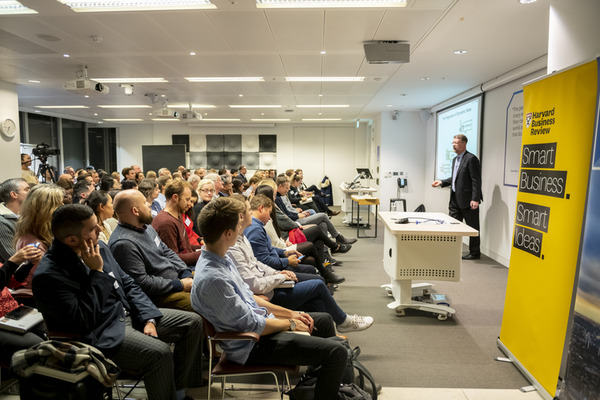
In late 2019, Harvard Business Press released a 20th-anniversary edition of Jim Gilmore and Joe Pine’s The Experience Economy. Pine conducted a book tour. In the UK, this included a talk at an event named ‘HBR Live: The Experience Economy’ at Warwick Business School in London, on Level 17 of The Shard.
Here are some key points from his inspiring, funny keynote speech he gave that evening.
Pine began with a stark statement that showed how things have changed in the 20 years since the first edition was published.
‘The most precious resource on the planet,’ he said, ‘is the time that individual human beings have. And the number one competitor to their time is the smartphone.’
Time is the key currency of the experience economy
As Pine observed, there are 3 currencies in the experience economy: Time, Attention and Money. Of those, time is the most important. And time is limited, scarce and consumable: once it’s gone, it’s gone.
There are 4 useful ways to think about the time someone spends with you and your company:
- Time wasted
- Time well saved
- Time well spent
- Time invested
Services deliver time well saved. Think food delivery services, cleaners etc. In terms of services, we’re searching for the cheapest and most convenient, to spend as little time as possible.
Experiences are the opposite: we want to spend time, doing this thing, creating this memory. That doesn’t mean an experience has to go on for a long time, of course. Think roller coasters and weekends away.
Transformative experiences
Even experiences can become commoditized – as heard in the phrase, ‘Been there, done that.’
But it is possible to customise experiences, by turning them into the fifth and final economic offering: transformations.
Two examples of organisations who offer transformations: Business Schools, and the new Transformational Travel Council (TTC), which is a collective of travel firms offering experiences designed to transform their customers.
You are what you charge for
During the time of the manufacturing economy, firms sold things and offered the services for free so that their customers would continue to buy their things. The true service economy began when firms started charging for the service.



IBM is the quintessential example of this: the firm rose to prominence as a creator and seller of mainframes, PCs, and other hardware. They would offer their services for free to help their clients install and maintain the equipment – in order to keep them buying their goods. By the 1990s, IBM had divested all its manufacturing and became a services firm.
At present, many firms still charge for things and services. Most don’t charge for experiences. Pine believes this is a mistake, and that firms should ask the question:
‘What would we do differently if we charged admission?’
3 examples of firms which charge for time:
● Guinness Storehouse in Dublin
● Ziferblat in Berlin, London etc – the cafe chain that charges for time. All the drinks are free.
● Wingtip in San Francisco – a clothing store that created a member’s club. Charging membership fees is a great way to charge for time.
Pine shared so much more – for instance he proposed two new metrics for measuring experiences: the money value of time (MVT) and return on experience (ROX).
We would advise you to get a copy of The Experience Economy and get one for everyone on your team too.
Article written by James Wallman


