
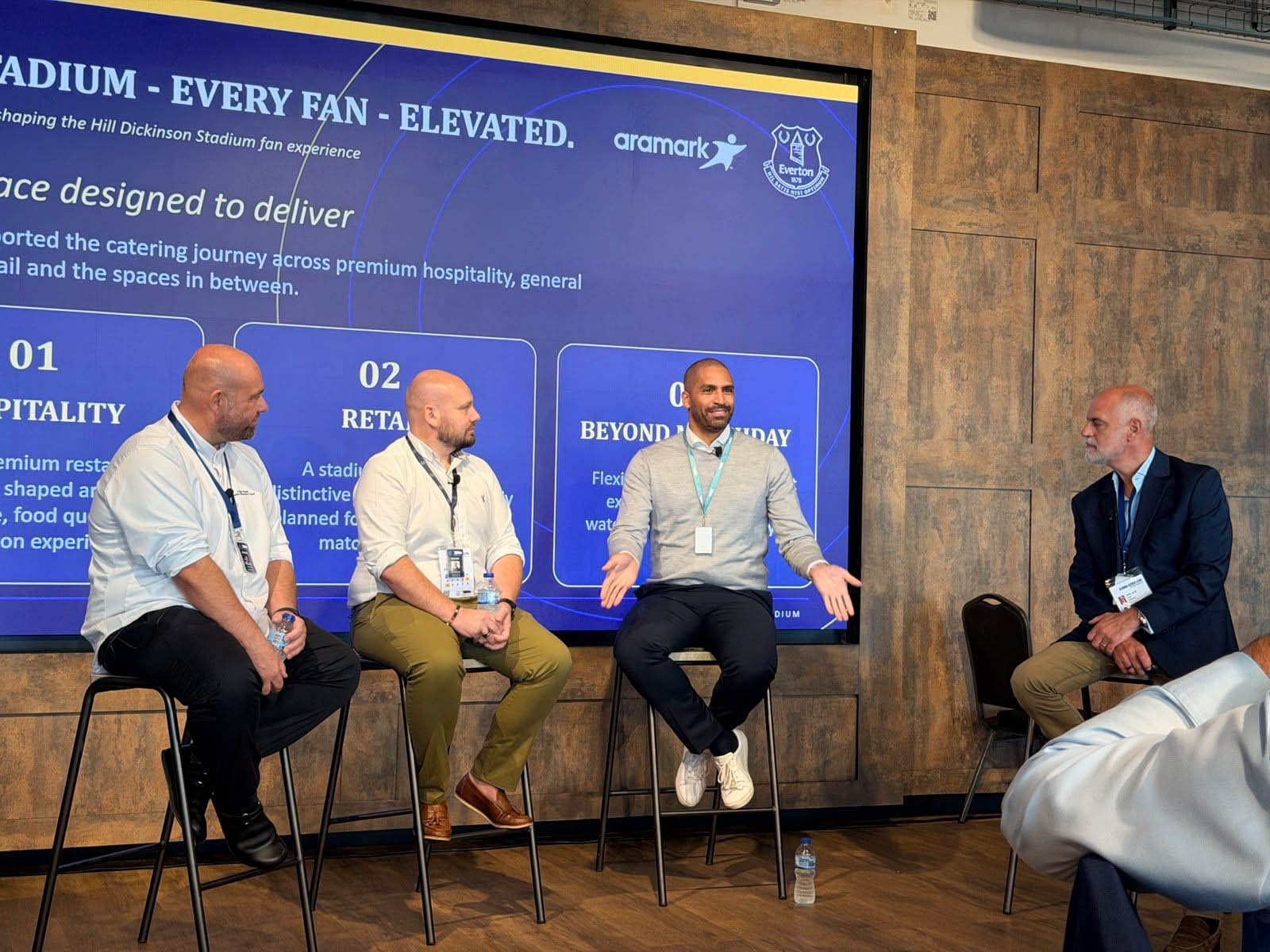
Aramark UK has highlighted the importance of prioritising supporter experience over operational convenience when developing stadium hospitality services, drawing on its work at Everton Football Club’s Hill Dickinson Stadium.
Speaking at Arena’s Behind the Scenes event, senior Aramark representatives discussed the challenges of designing and operating food and beverage services within the 52,769-capacity stadium, which opened in August 2025.
As Everton’s Official Culinary Experience Partner, Aramark manages year-round hospitality operations across the venue, representing its first Premier League club partnership.
The discussion provided insights for stadium developers, venue operators and hospitality designers seeking to balance operational efficiency with differentiated experiences across large-scale sporting destinations.
Bespoke Hospitality Concepts Support Different Audience Requirements
Matthew Gregoire, Food, Beverage and Experience Director at Aramark UK, explained that understanding Everton’s supporters and their connection to the club was central to developing the stadium’s hospitality offering.
The transition from Goodison Park required careful consideration of established supporter expectations alongside opportunities presented by the new venue.
Rather than introducing standardised menus across multiple areas, Aramark developed approximately 17 distinct menus, with variations reflecting fixture schedules and different hospitality requirements.
The stadium incorporates 14 restaurant concepts, three general admission plus bars and approximately 5,500 hospitality covers, alongside accommodation for around 48,000 general admission supporters.
Executive Chef Colin Smith highlighted the importance of creating individual culinary identities for each restaurant while maintaining menu flexibility across different matchday occasions.
For stadium hospitality designers, the approach demonstrates how varied dining concepts can support distinct audience segments within a unified venue operation.
Workforce Planning Plays A Central Role In Venue Operations
Beyond culinary development, Aramark identified recruitment, training and employee engagement as essential components of the supporter experience.
David Bartlett, HR Director at Aramark, discussed the importance of recruiting employees capable of delivering consistent service across different hospitality environments.
The stadium requires approximately 160 chefs and a wider workforce of around 2,200 employees supporting matchday and non-matchday activities.
Recruitment efforts incorporated local community engagement, with assessment centres initially operating three times weekly to establish the required workforce.




The staffing model highlights the operational scale involved in opening major sporting venues and the importance of workforce preparation during the transition into full operations.
Automated Retail Technology Improves Service Efficiency
Hill Dickinson Stadium has incorporated automated retail systems to address service speed and support efficient customer movement.
The venue currently operates four Just Walk Out stores and 20 electronic bars, providing alternatives to conventional food and beverage transactions.
According to Aramark, the average transaction through its Just Walk Out format takes approximately eight seconds.
Gregoire explained that adoption increased throughout the stadium’s first season as supporters became familiar with the venue’s layout and technology.
This gradual uptake highlights the importance of customer orientation, signage and operational support when introducing unfamiliar service formats within high-capacity venues.
Consumer Research Reinforces The Commercial Value Of Hospitality
Research presented by Amy Graham, Head of Consumer Insights at GXE Consumer, demonstrated the relationship between food and beverage quality and supporter behaviour.
The findings indicated that 56% of surveyed UK football supporters would arrive earlier for improved hospitality options, while 52% would remain at venues longer.
Additionally, 66% indicated a willingness to pay higher prices for better-quality food and drink.
For stadium operators, these findings suggest that hospitality investment can influence dwell time, spending patterns and overall venue performance.
Aramark’s experience at Hill Dickinson Stadium provides a practical reference for developing large-scale hospitality operations that combine personalised dining, workforce planning and automated service technology.
The project highlights the value of integrating commercial objectives with supporter expectations throughout stadium design and operational development.


